

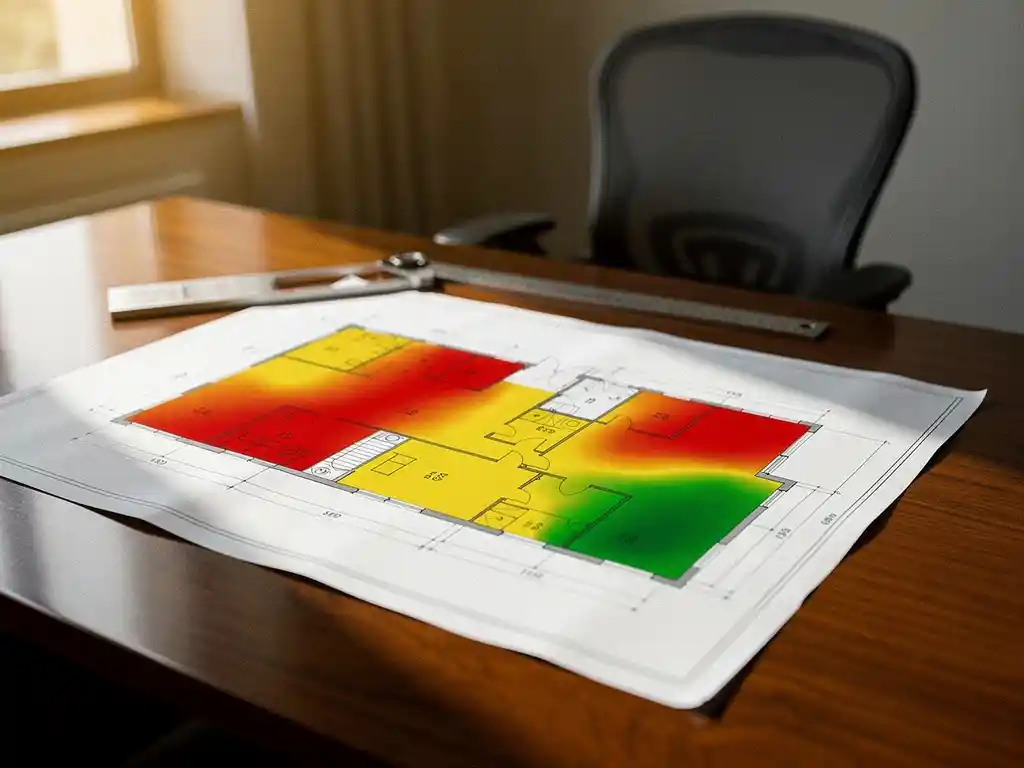
Modern offices face the challenge of making the most of their space in an era of hybrid work and flexible workspaces. Occupancy data provides insight into how employees actually use office spaces and forms the basis for smart design decisions. An office desk booking system plays a crucial role in this by collecting real-time data on workspace usage.
By analyzing occupancy patterns, organizations can tailor their office layouts to actual needs rather than assumptions. This leads to better use of space, higher employee satisfaction, and cost savings on real estate and facilities.
What is occupancy data, and why is it important for office design?
Occupancy data is measurement data that shows when, where, and for how long workstations, meeting rooms, and other office spaces are used. This data includes information about peak times, periods of low occupancy, and usage patterns for each room or zone.
Occupancy data is essential for office design because it provides objective insights rather than guesswork. Traditionally, offices were designed based on the maximum number of employees, but hybrid work has rendered this model obsolete. Data shows that many offices have an occupancy rate of only 60–70%, even on busy days.
This information helps organizations make informed decisions about the number of workstations, the layout of spaces, and the necessary facilities. As a result, organizations can transition from a static to a dynamic office layout that adapts to actual usage patterns. This leads to cost savings on real estate and a better work experience for employees.
How do you collect reliable occupancy data in your office?
You can collect reliable occupancy data by using a combination of digital sensors, reservation systems, and manual counts over a period of at least four weeks. A desk booking system forms the foundation for accurate data collection.
The most effective methods for data collection are:
- Smart booking systems: Digital platforms where employees book workstations and meeting rooms, automatically tracking usage
- Occupancy sensors: Infrared or motion sensors that detect presence without invading privacy
- WiFi analytics: Systems that count connected devices to estimate occupancy
- Manual counts: Periodic rounds to validate sensor and reservation data
To ensure accurate results, it is important to collect data across different seasons and work periods. Holiday periods, project deadlines, and special events can influence occupancy patterns. Always combine multiple data sources to get a complete picture of workplace usage.
What patterns in occupancy data can help inform design decisions?
Key patterns in occupancy data include peak hours versus quiet periods, popular versus underutilized areas, average occupancy duration, and seasonal fluctuations. These patterns reveal how employees actually work and which spaces are most valued.
Specific patterns that influence design decisions:
- Time-based patterns: Morning rush hour between 9:00 a.m. and 11:00 a.m. and an afternoon lull after lunch indicate when additional workspaces are needed
- Spatial patterns: Areas near windows or close to coffee stations are often more popular than secluded corners
- Patterns of duration: Short sessions (1–2 hours) versus full days highlight the need for different types of workspaces
- Team Structures: Departments that frequently collaborate benefit from being located close to one another
Underutilization of certain areas may indicate issues with lighting, noise levels, or accessibility. Overcrowding in other areas suggests a need to expand or reconfigure popular facilities, such as quiet rooms or collaborative zones.
How do you translate occupancy data into concrete layout changes?
To translate occupancy data into facility changes, first identify bottlenecks, then set priorities based on impact and cost, and finally implement phased adjustments. Start with quick wins before considering major investments.
Concrete steps for translating data into action:
Adjust the workstation ratio
If data shows that no more than 70% of workstations are occupied, you can switch to a flexible system with fewer assigned seats. This creates space for other purposes, such as relaxation areas or additional meeting rooms.
Redistricting
Popular areas can be expanded by repurposing underutilized spaces. For example, an underutilized archive can be transformed into additional flexible workspaces or a quiet zone for focused work.
Optimizing facilities
Meeting room occupancy data shows which sizes are in highest demand. Large rooms that are rarely full can be divided, while small rooms that are constantly occupied can be expanded or multiplied.
What are the benefits of data-driven office design?
Data-driven office design delivers cost savings of 20–30% on real estate expenses, increases employee satisfaction through better use of space, and enables flexible adjustments to changing work patterns. Organizations make decisions based on facts rather than assumptions.
The main advantages are:
- Financial savings: Less floor space required due to more efficient use of space; lower energy costs due to optimal occupancy
- Improved work experience: Employees find a suitable workspace more quickly, with less frustration over occupied spaces
- Future-proof: A flexible layout that adapts to changing work patterns and team sizes
- Better decision-making: An objective basis for investments in furniture, technology, and facilities
In addition, this fosters a culture of continuous improvement in which design decisions are regularly evaluated and adjusted based on new data. This prevents costly mistakes and ensures that the office always meets the organization’s actual needs.
How Wout Monseurs Helps with Data-Driven Office Design
We help organizations implement data-driven office layouts by combining our Smart Office solutions with over 60 years of experience in project design. Our approach seamlessly integrates occupancy data into the design process.
Our specific support includes:
- Deskbooking systems: Implementation of user-friendly reservation platforms that automatically collect occupancy data
- Data analysis and consulting: Interpretation of occupancy patterns and translation into specific design recommendations
- Flexible furniture solutions: Modular systems from brands such as Wini and Interstuhl that can be easily customized
- Phased implementation: A step-by-step approach in which organizational changes are tested and optimized
Our comprehensive office design process begins with a thorough analysis of your current occupancy data and work patterns. From the initial consultation through to completion, we ensure that your new office design perfectly aligns with your organization’s actual needs. Contact us for a no-obligation consultation about your data-driven office design.
Frequently asked questions
How long does it take to collect reliable occupancy data?
To obtain reliable occupancy data, you’ll need at least 4–6 weeks, but ideally you should collect data over a 3-month period to account for seasonal fluctuations and special events. Start immediately after implementing your desk booking system and combine this with manual counts to validate the accuracy.
How much does it cost to implement occupancy sensors and a desk booking system?
The cost ranges from €50 to €150 per workstation for a complete system, depending on the technology chosen and the size of the office. This investment typically pays for itself within 6 to 12 months thanks to the 20–30% space savings achieved through data-driven office design.
How do you address privacy concerns when collecting occupancy data?
Always use anonymous sensors that detect only presence, not personal data. Be transparent with employees about what data is being collected and why. Choose systems that are GDPR-compliant and do not store individual user patterns, only aggregated occupancy figures.
What common mistakes should you avoid when interpreting occupancy data?
Avoid making decisions based on insufficient data, don’t ignore seasonal patterns, and don’t draw conclusions based solely on peak periods. Also keep in mind that reservation systems don’t always accurately reflect actual usage—so always combine multiple data sources to get a complete picture.
How often should you review occupancy data and make adjustments to the layout?
Review occupancy data monthly to make operational adjustments and quarterly to plan structural layout changes. Plan major layout changes annually based on long-term trends. Also take into account organizational changes, such as team growth or new work patterns, that require immediate adjustments.
What do you do if certain areas remain chronically underutilized despite adjustments?
First, identify the causes: poor lighting, noise pollution, accessibility issues, or temperature problems. Address any infrastructure issues, or repurpose the space entirely for other uses, such as storage, a recreational area, or a quiet zone. Sometimes the location simply isn’t suitable for workspaces, and it’s better to invest in more popular areas.