

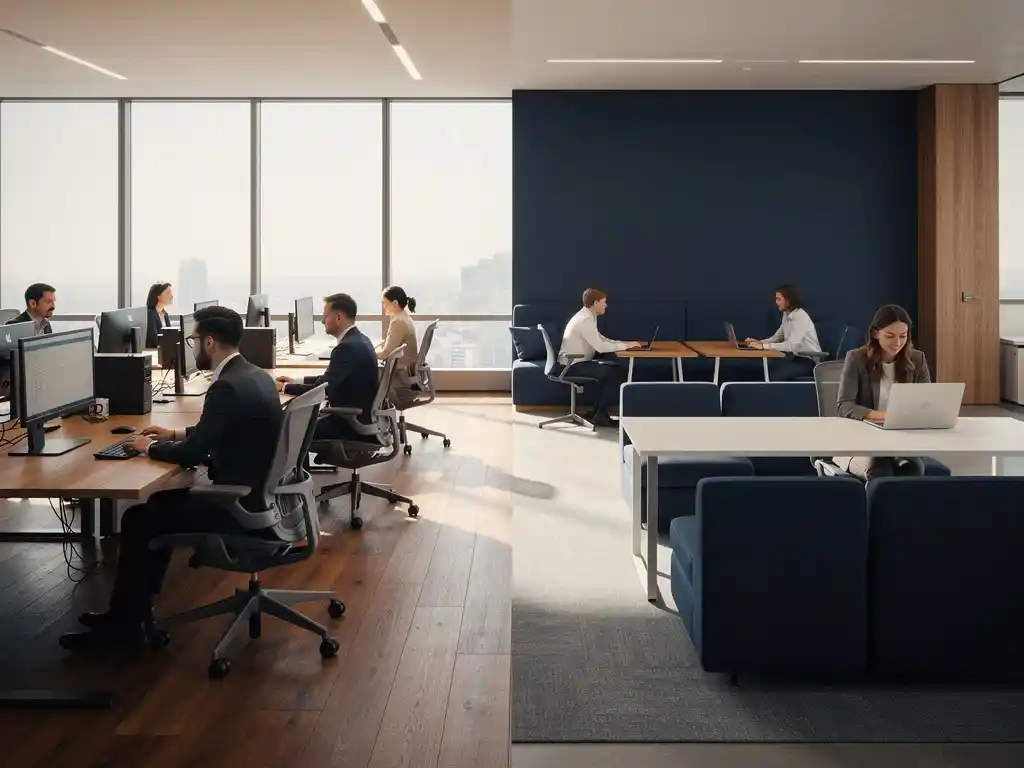
Choosing between a fixed and flexible workspace layout is one of the most important decisions companies face today. With the rise of hybrid work and changing employee expectations, organizations are seeking the optimal balance between structure and flexibility. An office desk booking system can play a crucial role in efficiently managing workspaces.
This decision has a direct impact on productivity, employee satisfaction, and operational costs. By choosing the right workplace layout, companies can not only optimize their space but also create a work environment that aligns with their corporate culture and objectives.
What is the difference between a fixed and a flexible workspace layout?
A fixed workstation layout means that each employee has their own assigned workstation, while a flexible workstation layout provides workstations that can be used by different employees based on availability and need.
In a fixed-seating arrangement, each employee has their own desk, chair, and personal space that is permanently assigned to them. This workspace can be personalized with photos, plants, and personal items. Employees know exactly where their workspace is located and can set it up exactly as they wish.
Flexible workspace layouts, on the other hand, utilize a system in which workspaces are shared. Employees reserve a workspace for the day or period they are in the office. This can range from fully open systems to partially reserved zones. An office desk booking system facilitates this process by allowing employees to reserve a workspace in advance via a digital application.
What are the benefits of a fixed workstation layout?
Fixed workstation layouts provide stability, a sense of ownership, and consistency for employees, which contributes to a sense of security and a sense of belonging in the workplace.
The main advantage is the ability to personalize your workspace. Employees can set up their workspace entirely to their own taste with personal items, ergonomic adjustments, and a layout that perfectly suits their work style. This fosters a sense of ownership and makes you feel at home in the office.
Fixed workstations also promote routine and structure. Employees know exactly where they’re going every day, which reduces stress and makes it easier to start the day. Plus, they can set up their workspace optimally, with all the necessary materials, documents, and equipment within easy reach.
For teams that collaborate frequently, dedicated workstations foster a sense of natural proximity. Team members are consistently seated together, which encourages spontaneous communication and collaboration. This is particularly valuable for projects that require close coordination.
Why do companies opt for flexible workplace layouts?
Companies are opting for flexible workplace layouts because they offer space efficiency, cost savings, and adaptability to modern work patterns, especially in hybrid work arrangements, where not all employees are in the office every day.
The main driver is space optimization. Research shows that fixed workstations are actually used only 40–60% of the time, on average. By introducing flexible workstations, companies can significantly reduce their office space and save on rent.
Flexible layouts are perfectly in line with the trend toward hybrid work. Employees who work in the office two or three days a week don’t need a permanent desk that sits empty the rest of the time. An office desk booking system makes it possible to allocate workspaces efficiently among all employees.
This approach also promotes diversity in the workplace. Employees can choose a quiet space for focused work, a collaborative area, or a space equipped with specific tools, depending on their daily tasks. This boosts productivity by tailoring the workspace to the specific activity.
What are the drawbacks of a flexible workspace layout?
Flexible workplace layouts can lead to a loss of personal connection to the workplace, increased stress from the daily search for a workspace, and challenges in building team cohesion due to changing seating arrangements.
A major drawback is the lack of personalization. Employees cannot leave personal items behind and have to set up their workspace from scratch every day. This can lead to a sense of alienation and a reduced sense of connection to the office.
The daily search for an available workspace can be stressful, especially during busy periods when popular spots fill up quickly. Employees have to spend time reserving workspaces and are not always able to secure their preferred location.
When it comes to team building, flexible working can be challenging. Team members no longer automatically sit together, which can make spontaneous interaction and building relationships more difficult. This requires a more conscious effort to maintain team cohesion.
In addition, new management challenges arise. An office desk booking system requires maintenance, employee training, and monitoring of usage. Workstations must also be cleaned daily and prepared for the next user.
How do you determine which workplace layout is right for your company?
The choice depends on factors such as company culture, employee work patterns, the type of work, office space, and budget. Assess how many days employees spend in the office, what kind of collaboration they need, and what the organization’s goals are.
Start by analyzing current work patterns. Over the course of several weeks, track how many workstations are actually in use and at what times. If the occupancy rate is consistently below 70%, a flexible layout could lead to cost savings.
Consider the nature of the work. Creative teams that do a lot of brainstorming and collaborate frequently often benefit from dedicated workstations that ensure proximity. Employees who primarily perform individual tasks or regularly have external meetings are better suited to flexible workspaces.
Corporate culture also plays a crucial role. Traditional organizations with strong hierarchies often opt for fixed workstations, while innovative companies with an open culture are better suited to flexible concepts.
Budget considerations are also important. While flexible workspaces can lead to lower rental costs, they require investments in technology—such as an office desk booking system—as well as additional cleaning and, potentially, adjustments to the office layout.
How Wout Monseurs Helps Optimize Workplace Layout
We offer a comprehensive solution for both fixed and flexible workplace layouts, from design to implementation. With over 60 years of experience in office design, we help companies make the right choice based on their specific needs and objectives.
Our services include:
- Customized advice: We analyze your current work patterns and corporate culture to determine the optimal workplace layout.
- Smart Office technology: Implementation of desk booking systems and automatic desk assignment based on personal preferences.
- Ergonomic furnishings: A selection of high-quality, adjustable furniture from brands such as Wini, Interstuhl, and Voortman.
- Flexible zones: Design of modular workspaces that can be easily adapted to changing needs.
- Complete project design and implementation: From design to completion, including acoustic solutions and landscaping.
Whether you choose a traditional fixed layout, a fully flexible concept, or a hybrid solution, we’ll create a work environment that promotes productivity and employee satisfaction. Contact us for a no-obligation consultation on the workplace layout that best suits your organization.
Frequently asked questions
How long does it take to transition from a fixed to a flexible workspace layout?
A transition typically takes 3–6 months, depending on the size of your organization. This includes employee surveys, system implementation, training, and a phased rollout. We recommend a 4–6-week pilot phase with a small group to test the system before the full rollout takes place.
What are the average cost savings associated with flexible workspaces?
Companies can save 20–30% on office space by adopting flexible workspaces, which translates to €2,000–4,000 per workstation per year in rental costs. The initial investment in a desk-booking system and related modifications is typically recouped within 12–18 months through lower real estate costs.
How can you prevent popular workspaces from always being occupied?
Implement a fair reservation system with time limits, rotation of premium locations, and incentives for less popular spots. Also, create different work zones (quiet, collaborative, phone calls) to spread out demand and ensure sufficient diversity in workspace options.
What are the technical requirements for a desk booking system?
A modern desk booking system requires a stable Wi-Fi connection, integration with existing IT systems (such as Outlook), occupancy sensors, and a user-friendly app. In addition, QR codes at workstations, automatic check-in/check-out functionality, and real-time availability overviews are essential for optimal use.
How do you maintain team cohesion in flexible work environments?
Reserve dedicated team areas for key project phases, organize regular team lunches, and use digital tools for communication. Also, schedule intentional face-to-face meetings and consider “buddy systems” where team members reserve workspaces together to stay close to one another.
What if employees are resistant to flexible workspaces?
Start by thoroughly communicating the benefits and involving employees in the design of the new system. Organize trial periods, gather feedback, and adapt the system based on their experiences. Also, provide transition support and training to ensure a smooth transition.
Can we implement a hybrid model that includes both fixed and flexible workspaces?
Yes, a hybrid model is often the best solution. Allocate 60–70% of the space to flexible workstations and 30–40% to dedicated desks for core team members or specific roles. This provides flexibility for most employees while allowing key teams to remain in close proximity for intensive collaboration.