

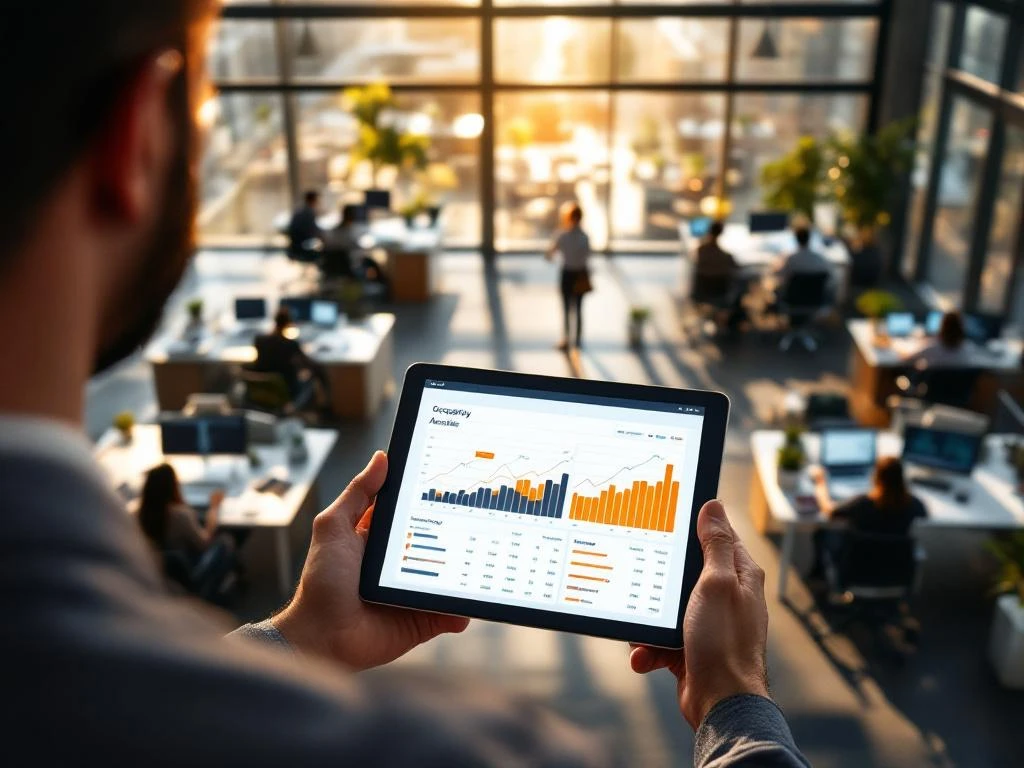
You can measure an office’s occupancy rate by comparing the number of workstations actually in use to the total number of available workstations. This can be done through manual counts, sensors, or smart office technology. Accurate measurement helps optimize office space, reduce costs, and improve employee satisfaction.
What is occupancy rate, and why is it important for offices?
Occupancy rate shows the percentage of your office space that is actually in use during a given period. It indicates how many workstations, meeting rooms, or other facilities are occupied relative to the total number of available spaces.
Measuring occupancy rates offers tangible benefits for your organization. It gives you insight into which spaces are underutilized and where cost savings are possible. Many companies are discovering that they are renting more office space than they need, especially with the rise of hybrid work.
Occupancy rates also play a key role in employee satisfaction. Overcrowded spaces lead to stress and reduced productivity, while empty offices can create a sense of isolation. By striking the right balance, you can create a pleasant work environment.
Space optimization is made possible by identifying patterns. You can see which days and times are busiest, which departments need more or less space, and where adjustments to the office layout are needed.
What methods can you use to measure office occupancy?
There are various measurement methods, ranging from simple manual counts to advanced automated systems. The choice depends on your budget, desired accuracy, and office size.
Manual counts are the most basic method. Employees or facilities staff count the number of occupied workstations at set times. This is inexpensive but labor-intensive and can be inaccurate due to human error.
Wi-Fi tracking uses laptop and smartphone connections to track attendance. This method provides a reasonably accurate picture without requiring additional hardware, but raises privacy concerns and can be skewed by guests or visitors.
- Motion sensors detect activity in rooms and provide real-time data
- Door contacts detect when rooms are entered and exited
- Camera analysis automatically counts people (with privacy safeguards)
- Smart desk sensors instantly detect whether workstations are in use
Automated systems offer the highest accuracy and can measure continuously without human intervention. While they do require a higher initial investment, they provide more reliable data in the long run.
How often should you measure your office occupancy rate?
The frequency of measurement depends on your objectives and the size of your office. To ensure reliable results, you should measure for at least four weeks—preferably eight to twelve weeks—to accurately identify seasonal and work patterns.
For smaller offices (up to 50 workstations), a measurement every two hours during business hours is sufficient. This provides enough data points without becoming too labor-intensive. Larger offices benefit from continuous monitoring or hourly measurements.
Seasonal trends have a significant impact on occupancy rates. Summer vacations, holidays, and school breaks result in lower occupancy. Therefore, be sure to track occupancy during both busy and slow periods to get a realistic average.
Work patterns such as remote work days, flexible hours, and part-time contracts require regular follow-ups. Schedule measurements over several weeks and months to capture all variations. One-time measurements provide a distorted picture.
For organizations implementing major changes, such as relocations or new work processes, more frequent assessments are recommended. In such cases, conduct monthly assessments to quickly adjust for the impact of these changes.
What are the most important occupancy rate KPIs you should track?
The average occupancy rate shows the overall usage of your office space over a specific period. This percentage provides insight into whether your space is being used efficiently and serves as the basis for further optimization.
Peak occupancy measures the highest occupancy rate during busy periods. This KPI is crucial for planning facilities such as parking spaces, cafeteria capacity, and climate control. Excessively high peaks can lead to overcrowding and uncomfortable working conditions.
Space efficiency ratios compare different areas within your office. This allows you to see which departments require more or less space and where a reorganization could be beneficial. This ratio helps you make informed decisions about space allocation.
- Daily occupancy patterns show when the office is busiest and quietest
- Workstation rotation indicates how often individual workstations change hands
- Meeting room utilization shows whether you have enough or too many meeting facilities
- No-show rates measure the percentage of reserved spots that are ultimately not used
These KPIs help inform specific decisions regarding office layout, lease agreements, and investments in new facilities. Regular monitoring helps prevent underutilization and overcapacity.
How Wout Monseurs helps with smart traffic monitoring systems
We implement advanced smart office technology that provides real-time insights into your office’s occupancy rates. Our systems combine various sensors and data analysis to deliver accurate measurements without compromising employee privacy.
Our solutions integrate seamlessly with your existing office infrastructure and provide user-friendly dashboards where you can view all occupancy data. The systems operate automatically and require minimal maintenance, giving you continuous monitoring without adding to your workload.
- IoT sensors that detect motion and presence in all rooms
- Smart climate control that adapts to actual occupancy
- Automated reports with actionable insights for management
- Integration with popular software such as Microsoft Teams and Google Workspace
The implementation process begins with a thorough analysis of your current office layout and work patterns. We advise you on the best sensor placement and handle the entire installation and configuration. After implementation, we provide training and support to help you get the most out of your smart office system.
Would you like to learn how smart traffic monitoring can make your office more efficient? Contact us for a no-obligation consultation and discover the possibilities for your organization.
Frequently asked questions
What is the optimal occupancy rate for a modern office?
An optimal occupancy rate is typically between 60% and 80%. This provides enough flexibility for peak days and ensures that employees don’t feel like they’re working in an empty space. With hybrid work models, this percentage may be lower—around 40% to 60%—depending on your remote work policy.
How do you address employees' privacy concerns when measuring occupancy rates?
Communicate transparently about the purpose of the measurements and use anonymous data. Choose sensors that only detect presence, not identify individual people. Involve the works council in drafting a privacy protocol and ensure GDPR compliance in all data collection.
What should you do if your occupancy rate is consistently too low?
If your office occupancy rate remains consistently low, you may want to consider downsizing your office space, sharing it with other companies, or leasing it to third parties. You could also repurpose the space for other uses, such as additional meeting rooms, relaxation areas, or training rooms, to boost employee satisfaction.
What are the costs associated with implementing a smart office system?
The cost ranges from €50 to €200 per workstation, depending on the complexity of the system. This includes sensors, software, installation, and the first year of support. The payback period is typically 12 to 24 months, thanks to savings on rent, energy, and facility costs.
How can you prevent employees from circumventing or manipulating the system?
Use multiple measurement methods simultaneously and place sensors strategically. Explain why these measurements are important for everyone’s well-being and involve employees in improving the office environment. Make it clear that this is not about monitoring individuals, but about optimizing the use of space.
What is the difference between capacity utilization and utilization rate?
Bezettingsgraad meet hoeveel plekken bezet zijn op een bepaald moment, terwijl utilizatiegraad kijkt naar hoe effectief de ruimte wordt gebruikt over langere tijd. Een hoge bezettingsgraad betekent niet automatisch goede utilizatie – werkplekken kunnen bezet zijn maar niet productief gebruikt worden.
How do you adjust your office layout based on occupancy data?
First, analyze the data to identify patterns: which areas are underutilized, and where are bottlenecks occurring? Next, create flexible zones that can be adapted to changing needs. Consider modular furniture and multifunctional spaces that can serve different purposes depending on occupancy.