

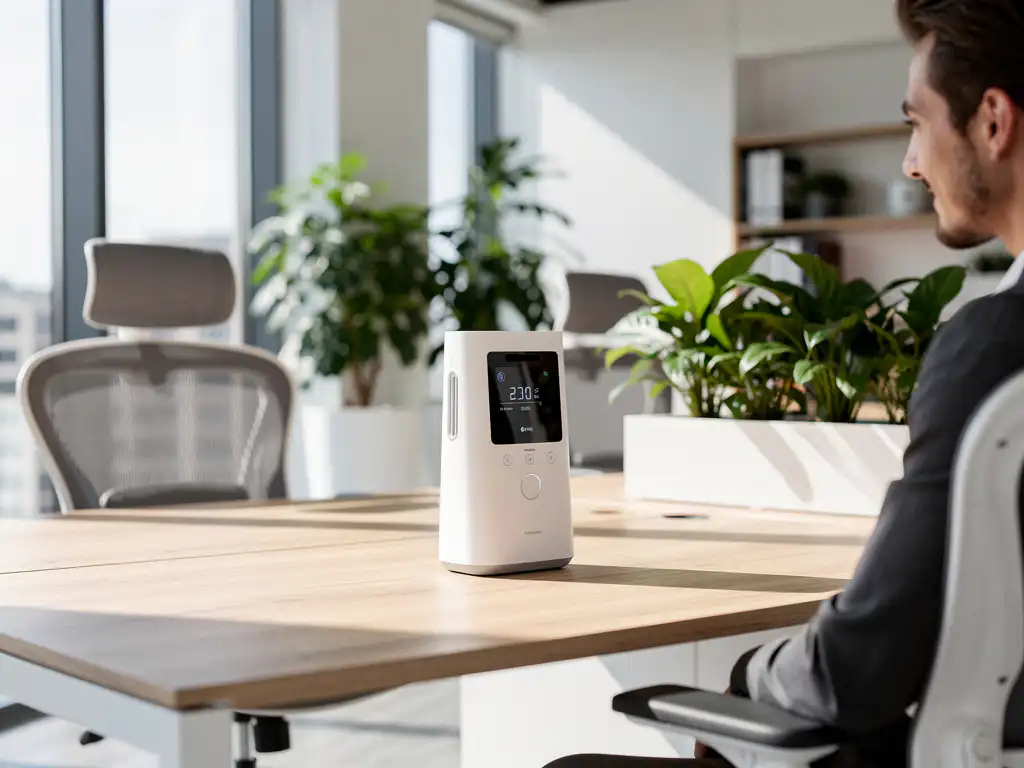
Good air quality is essential for a productive and healthy work environment. However, many offices struggle with issues such as dusty air, high CO2 levels, and inadequate ventilation, which can lead to reduced concentration, headaches, and even absenteeism among employees.
Measuring air quality in office spaces is the first step toward creating an optimal work environment. With the right monitoring equipment and knowledge of the ideal standards, you can proactively identify issues and implement targeted improvements. Modern smart sensors for the office environment make it possible to gain real-time insights into various air quality parameters.
What is air quality, and why is it important for office spaces?
Air quality refers to the composition and purity of the air in an indoor space, as measured by parameters such as CO2 concentration, humidity, temperature, and the presence of harmful substances. In office spaces, air quality directly affects employees’ health, comfort, and productivity.
Poor air quality in offices can lead to what is known as “sick building syndrome,” in which employees experience symptoms such as fatigue, headaches, eye irritation, and respiratory problems. Research shows that improving air quality can boost employees’ cognitive performance by 15% and significantly reduce absenteeism.
In today’s office environment, with well-insulated buildings and limited natural ventilation, it is especially important to actively monitor air quality. Particularly in open-plan offices, where many people work in close proximity to one another, problems can quickly arise that negatively impact the work environment and health.
What factors affect indoor air quality in offices?
Air quality in offices is influenced by both internal and external factors, with CO2 emissions from employees, ventilation efficiency, office materials, and outdoor air pollution playing the most significant roles.
Internal factors include employee breathing, which increases CO2 levels, especially in heavily used meeting rooms. Office supplies such as furniture, carpeting, and cleaning products can release volatile organic compounds (VOCs). Printers and copiers produce ozone and particulate matter, while inadequate cleaning leads to dust buildup.
External factors are primarily related to the ventilation system and outdoor air. A poorly maintained HVAC system can circulate contaminated air, while filters that are not replaced regularly lose their effectiveness. The building’s location also plays a role: offices located on busy roads are exposed to more exhaust fumes and particulate matter from traffic.
Seasonal factors such as pollen in the spring, increased humidity in the summer, and reduced ventilation in the winter due to closed windows also affect air quality in office spaces.
How do you measure CO2 levels in your office space?
You can measure CO2 levels using a CO2 meter or air quality sensor placed at various locations throughout your office, preferably at breathing height and away from direct ventilation vents. These devices provide real-time readings in parts per million (ppm) and alert you when concentrations become too high.
For accurate measurements, it is important to use multiple measurement points, especially in large office spaces. Place sensors in different areas: workstations, meeting rooms, the cafeteria, and near ventilation inlets. Take measurements at different times of the day to identify patterns, as measurements taken in the morning, afternoon, and evening may yield different results.
Modern smart sensors for the office environment offer the advantage of continuous monitoring and can be linked to smartphone apps or computer systems. These sensors store historical data, allowing you to analyze trends and identify patterns related to occupancy rates, seasons, or specific activities.
When taking measurements, be aware of external factors that could affect the results, such as open windows, running ventilation systems, or the presence of plants, which can absorb CO2 and skew the measurements.
What equipment do you need to measure air quality?
For comprehensive air quality measurements, you need a multi-parameter air quality monitor that measures at least CO2, temperature, humidity, and particulate matter (PM2.5). Professional devices also measure volatile organic compounds (VOCs) and can store and analyze data.
Basic air quality monitors cost between 50 and 200 euros and are suitable for small offices. These devices show real-time readings on a display and often provide color-coded alerts. For larger office spaces, wireless sensor systems are ideal; they send data to a central hub and can be monitored via apps.
Professional systems, which cost between 500 and 2,000 euros, offer advanced features such as automatic logging, trend analysis, and integration with building management systems. These systems can control multiple sensors and provide dashboards that allow facility managers to monitor air quality throughout the building.
Specialized monitors are available for specific applications: CO2 monitors for conference rooms, particulate matter monitors for offices near busy roads, and VOC monitors for newly furnished spaces where materials may still be off-gassing.
What are the ideal air quality standards for offices?
The ideal CO2 concentration in offices is below 800 ppm, with levels between 400 and 600 ppm being optimal for cognitive performance. Humidity should remain between 40 and 60%, while the temperature should ideally be between 20 and 24°C for maximum comfort and productivity.
For fine particulate matter (PM2.5), the limit is set at a maximum of 25 μg/m³ per day, although lower levels are better for health. Volatile organic compounds (VOCs) must not exceed 300 μg/m³, although new office spaces may temporarily show higher levels due to off-gassing from materials.
The Dutch Working Conditions Act stipulates that employers are required to provide healthy working conditions, which means that indoor air quality must remain within acceptable limits. International standards such as ASHRAE 62.1 and EN 15251 provide more specific guidelines for different types of spaces.
- CO2: below 800 ppm (ideally 400–600 ppm)
- Humidity: 40–60%
- Temperature: 20–24°C
- PM2.5: below 25 μg/m³
- VOCs: below 300 μg/m³
These standards may vary depending on the season, the type of work being performed, and the specific needs of employees, but they provide a solid starting point for assessing air quality in office spaces.
How do you improve air quality after taking a measurement?
After taking measurements, you can improve air quality through targeted measures, such as optimizing ventilation, placing air-purifying plants, upgrading air filters, and adjusting work habits. The most effective approach combines technical improvements with employee awareness.
Optimizing ventilation is often the most effective measure. Ensure an adequate supply of fresh air by properly adjusting and regularly maintaining HVAC systems. In rooms without mechanical ventilation, simply opening windows regularly can help, especially during breaks and after meetings.
Air-purifying plants such as snake plant, pothos, and peace lily can help remove VOCs and increase oxygen production. Place them strategically in workspaces and conference rooms for maximum effect. Professional air purification systems with HEPA filters are effective against fine particulate matter and allergens.
Practical improvements include regularly replacing HVAC filters, minimizing sources of pollution—such as certain cleaning products—and raising employee awareness about the importance of air quality and their role in it.
How Wout Monseurs Helps with Smart Air Quality Solutions
We integrate advanced air quality monitoring into our Smart Office solutions, giving you real-time insight into the air quality in your office space. Our smart sensors continuously measure CO2 levels, humidity, temperature, and particulate matter, and automatically send alerts to facility managers when readings fall outside the ideal range.
Our comprehensive approach to healthy office spaces includes:
- Installation of wireless air quality sensors in all workspaces
- Integration with building management systems for automatic ventilation adjustment
- Dashboard solutions for real-time monitoring and historical analysis
- Recommendations for optimal room layout to improve air circulation
- Selection of air-purifying plants and green wall systems
With over 60 years of experience in office design, we combine traditional expertise with modern technology to create healthy work environments that contribute to the well-being and productivity of your employees. Contact us for a no-obligation consultation on air quality in your office.
Frequently asked questions
How often should I measure the air quality in my office?
To get a complete picture, we recommend taking continuous measurements using smart sensors. If you’re taking measurements manually, do so at least 2–3 times a day at different times (morning, afternoon, end of the day) and in different rooms. Also take additional measurements during busy periods, after meetings, and when there are changes in occupancy.
What should I do if the CO2 levels in my conference room regularly exceed 1000 ppm?
Immediately increase ventilation by opening windows or adjusting the ventilation system. Limit the number of people per meeting or shorten the duration of long meetings. If possible, install an automatic ventilation system that responds to CO2 levels, and schedule regular breaks to let the room “breathe.”
Can air quality monitors give false alarms, and how can I prevent this?
Yes, inaccurate readings can occur due to improper placement near ventilation grilles, direct sunlight, or heat sources. Calibrate your equipment regularly according to the manufacturer’s instructions, place sensors in stable locations at breathing height, and compare readings across different devices to ensure accuracy.
What are the most common air quality issues in Dutch offices?
The most common problems include excessively high CO2 levels due to inadequate ventilation (especially in the winter), low humidity caused by heating, and elevated levels of particulate matter in city centers. VOC emissions from new furniture and cleaning products are also common in recently renovated offices.
How can I get my employees involved in improving air quality?
Display air quality data on screens or through apps, train employees to recognize the symptoms of poor air quality, and establish simple protocols, such as opening windows after meetings. Appoint an “air quality ambassador” for each department and regularly solicit feedback on comfort levels and any complaints.
Is it always necessary to invest in expensive professional air quality equipment?
Not always—start with affordable basic meters (€50–200) to identify issues. Invest in professional systems (€500–2000) if you have large office spaces, want to analyze historical data, or need automatic integration with building systems. The health benefits and productivity gains often justify the investment.
What are the legal obligations for employers regarding air quality?
Under the Dutch Working Conditions Act, employers are required to provide healthy working conditions, including good air quality. Although the law does not specify any CO2 limits, you must take demonstrable measures in response to complaints. Document your measurements and corrective actions in case of an inspection by the Labor Inspectorate.