

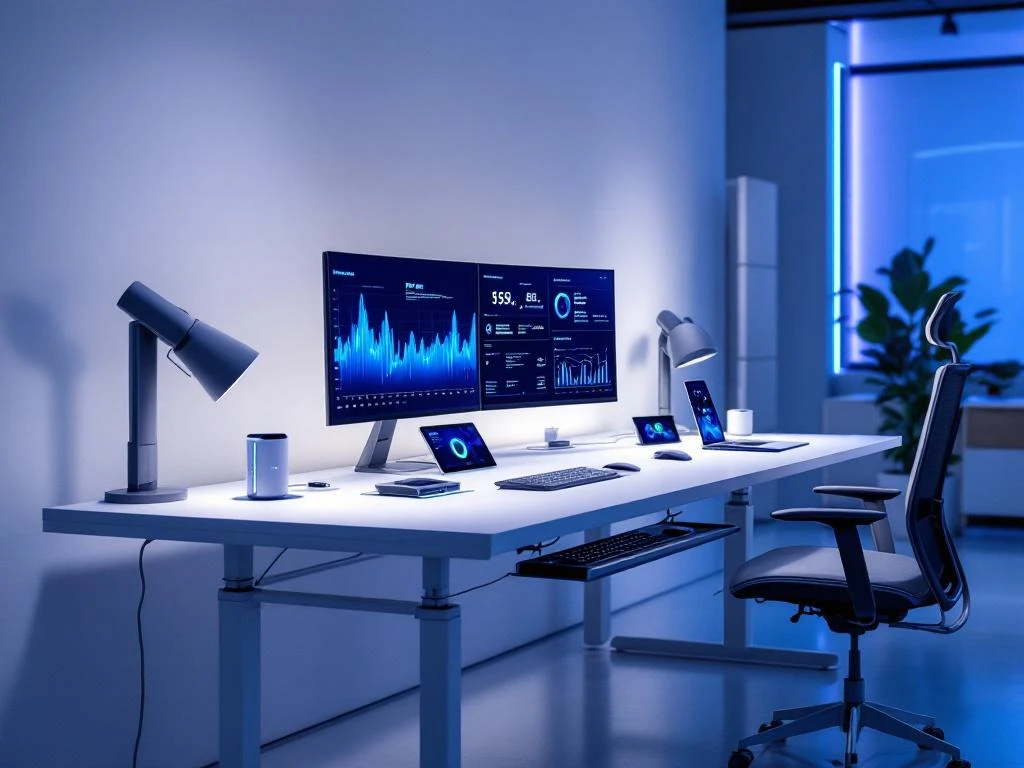
Smart workplaces increase efficiency by combining technology, ergonomics, and flexibility. They make daily tasks faster and easier through automation, improve employee well-being with ergonomic furniture, and adapt to different working styles. The result is higher productivity, fewer physical complaints, and better collaboration between teams.
What are smart workplaces and why do they make a difference?
A smart office integrates technology, ergonomic furniture, and flexible layouts to optimize workplace functionality. These workspaces adapt to your needs rather than the other way around. They combine smart lighting, automatic temperature control, height-adjustable desks, and digital tools that work together.
The difference lies in the seamless integration of all elements. Traditional offices have separate components that do not communicate with each other. Smart offices create an ecosystem where everything works together. Your desk knows when you arrive, the lighting adjusts to daylight, and your digital tools are immediately available.
This approach increases productivity because you spend less time adjusting your workspace. Employees feel more comfortable and can concentrate better. The result is a workspace that thinks along with you and supports you instead of hindering you.
How does technology in the workplace increase your productivity?
Technology increases productivity by automating routine tasks and creating an optimal working environment. Smart lighting automatically adjusts to daylight, reducing eye strain. Automatic temperature control keeps the room comfortable without you having to pay attention to it.
Digital tools play a major role in more efficient work processes. Cloud storage ensures that your files are available everywhere. Video conferencing systems that start up automatically save time at the beginning of meetings. Smart whiteboards automatically save notes and share them with the team.
Noise control through smart systems helps with concentration. These systems can adjust background noise or create noise-canceling zones. The result is that you are less distracted and can focus more deeply on important tasks.
What role does ergonomics play in an efficient workplace?
Ergonomics prevents physical complaints and keeps your energy levels up throughout the working day. A well-designed workspace ensures that your body remains in a natural position, reducing tension in your neck, shoulders, and back. This means fewer breaks due to discomfort and improved focus.
Height-adjustable desks allow you to alternate between sitting and standing. This variation improves your blood circulation and keeps you more alert. An ergonomic chair supports your natural back curvature and reduces pressure on your spine. The correct monitor height ensures that your neck remains in a neutral position.
The effect on productivity is immediately noticeable. Employees with ergonomic workstations suffer less from fatigue and can concentrate on their work for longer periods of time. They also take less sick leave due to work-related complaints. This means more effective working hours and better results.
How can you create flexibility in your office design?
Flexibility is created through modular furniture and multifunctional zones that adapt to different tasks and working styles. Mobile desks, folding tables, and movable partitions allow you to quickly reconfigure the space. This approach supports both individual work and team projects.
Create different zones for different activities: a quiet zone for concentrated work, a collaborative space for brainstorming sessions, and informal meeting places for spontaneous conversations. Each zone has its own design and atmosphere that suits the type of work.
Technology supports this flexibility through wireless systems and cloud solutions. Employees can continue their work anywhere in the office without being tied to a fixed location. This increases collaboration because teams can gather where it is most convenient for their project.
How Wout Monseurs assists with smart office solutions
We support you in creating a complete smart office by combining design, implementation, and aftercare. Our team analyzes your work processes and translates them into an office design that increases efficiency. We ensure the right balance between technology, ergonomics, and flexibility.
Our expertise lies in high-quality ergonomic furniture and project design that precisely meets your needs. We guide you through the entire process, from the initial sketch to delivery and maintenance. Thanks to our many years of experience, we know which solutions really work in practice.
Would you like to know how a smart office can help your business? Contact us for a no-obligation consultation. We would be happy to discuss your requirements and show you how smart workplaces can increase your efficiency.
Frequently asked questions
What are the costs of implementing a smart office?
The costs vary greatly depending on the size of your office and the technology you want. A basic setup with ergonomic furniture and smart lighting starts at around €2,000-€5,000 per workstation. For a complete smart office with advanced automation, you can expect to pay €5,000-€10,000 per workstation. We always recommend a phased approach to spread the investment.
How long does it take to implement a smart office?
A complete smart office implementation takes an average of 4-8 weeks, depending on the complexity and size. The first phase (design and planning) takes 1-2 weeks. The physical implementation and installation of technology usually takes 2-4 weeks. This is followed by another week for fine-tuning and training employees.
What technical skills do employees need for a smart office?
Most smart office systems are designed for ease of use and require minimal technical knowledge. Employees can usually learn how to operate height-adjustable desks and use smart systems within a day. We always offer training and support to ensure a smooth transition. The systems operate largely automatically in the background.
Can existing office furniture be integrated into a smart office?
Yes, many existing pieces of furniture can be retained and upgraded with smart components. For example, traditional desks can be fitted with electric adjustment mechanisms, and existing lighting can be replaced with smart LED systems. We always assess what can be reused in order to save costs and promote sustainability.
How do you measure the success of a smart office implementation?
Succes wordt gemeten aan de hand van concrete KPI’s zoals verhoogde productiviteit (gemiddeld 15-25% verbetering), verminderd ziekteverzuim door fysieke klachten, en verbeterde medewerkertevredenheid. We monitoren ook energiebesparing door slimme systemen en ruimtebenutting. Na 3 maanden evalueren we de resultaten en maken indien nodig aanpassingen.
What if employees resist the new smart office?
Weerstand is normaal bij verandering en wordt het beste aangepakt door medewerkers vroeg te betrekken bij het ontwerpproces. We organiseren demonstraties en workshops om de voordelen tastbaar te maken. Een geleidelijke implementatie helpt ook – start bijvoorbeeld met één afdeling als pilot. Meestal verdwijnt weerstand snel zodra medewerkers de dagelijkse voordelen ervaren.
What maintenance does a smart office require and how much does it cost?
Smart office systems require minimal maintenance thanks to modern technology. Annual maintenance costs are around 5-10% of the initial investment. This includes software updates, sensor calibration, and preventive maintenance of mechanical parts. We offer maintenance contracts that cover all technical aspects, so your team can focus on their work.