

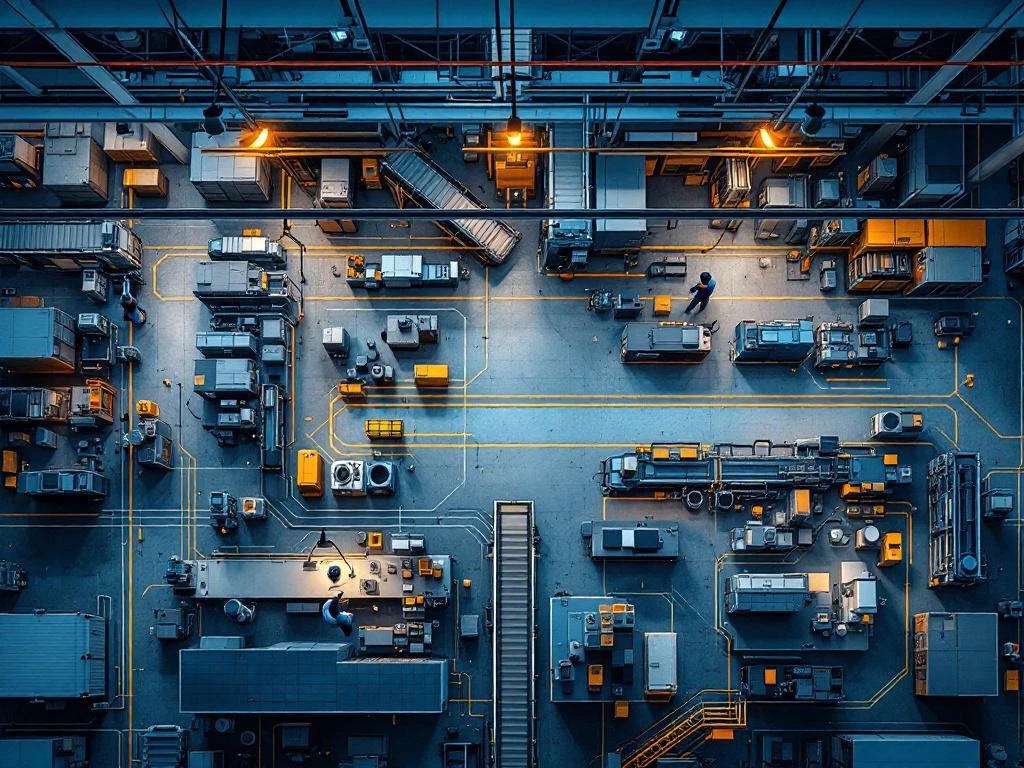
Project design for manufacturing companies and warehouses differs significantly from standard office design. It involves creating functional workplaces that meet industrial requirements, such as safety regulations, ergonomics for standing work, and efficient logistics flows. Good project design combines productivity with employee satisfaction through smart use of space and a well-thought-out workplace layout.
What is project layout and why is it different for manufacturing companies?
Project design for manufacturing companies involves designing and furnishing complete industrial workspaces according to specific business requirements. It differs from regular office design because you have to take into account production processes, safety standards, and physically demanding work.
Unlike traditional offices, manufacturing companies face unique challenges. Your employees often stand for long periods of time, work with machines, and have to move goods. This means you need different furniture, such as adjustable workbenches, anti-fatigue mats, and ergonomic lifting aids.
Warehouse spaces require a completely different approach than office spaces. You need to optimize logistics flows, integrate storage systems, and ensure that work areas remain accessible for forklifts and other equipment. The layout must be flexible to accommodate seasonal fluctuations and business growth.
In addition, safety regulations play a much greater role. You must comply with health and safety legislation, fire safety regulations, and industry-specific standards. This affects everything from the choice of materials to the positioning of emergency exits and first aid facilities.
What challenges are involved in designing production areas?
The biggest challenges when designing production areas are safety regulations, noise management, climate control, and combining different functions within a single space. Every production environment has unique requirements that you need to translate into practical solutions.
Safety regulations often form the basis of your layout plan. You must take escape routes, fire safety, and workplace safety into account. This means that you cannot use certain materials and that aisles must have a minimum width. You must also ensure adequate lighting and marking of hazardous areas.
Sound insulation is another important factor. Production areas can be noisy, which can affect nearby office spaces or concentration work. You can solve this by using sound-absorbing materials, strategically placing machines, or installing sound barriers between different zones.
Climate control plays a major role in the comfort and productivity of your employees. Production processes can generate heat, which requires good ventilation and possibly air conditioning. At the same time, you need to control energy costs and ensure a healthy working environment.
Combining office and production spaces adds extra complexity. You need to create different zones, each with its own function, but which also fit together well. Think of reception areas for customers, meeting rooms for consultations, and quiet workspaces for administrative tasks.
How do you plan an efficient warehouse layout that really works?
An efficient warehouse layout starts with analyzing your logistics flows and determining optimal routes for goods and personnel. You need to separate incoming and outgoing flows and ensure that frequently used items are easily accessible.
Start by mapping out your current processes. What goods come in, where are they stored, and how do they leave the warehouse? Identify bottlenecks and inefficiencies in your current workflow. This will give you insight into which areas you should prioritize in the new layout.
Next, choose the right storage systems for your specific products. Heavy items should be stored at eye level or lower, while lighter items can be stored higher up. Consider different systems, such as pallet racks, bin racks, or automated storage systems, depending on your budget and needs.
Position workstations strategically throughout the warehouse. Packing stations should be close to the shipping area, and quality control should be easily accessible from the receiving area. Ensure that each workstation has sufficient space and is well lit.
Take future growth and changes into account. Design your layout to be flexible so that you can easily expand or adapt processes. Modular systems make it possible to make adjustments later without changing the entire layout.
What ergonomic aspects are important in production environments?
Ergonomics in production environments focuses on preventing physical complaints by adapting workstations to the natural movements of employees. This means adjustable workbench heights, good lighting, the right floor covering, and aids for lifting tasks.
Workbench heights must be adjustable, because not everyone is the same height. A good workbench allows your employees to stand upright without having to bend their backs. For precision work, the ideal height is slightly higher than for heavy work. Investing in electrically adjustable workbenches pays for itself in reduced absenteeism.
Anti-fatigue mats are important for employees who stand for long periods of time. These mats reduce pressure on the legs and back and encourage small movements that improve blood circulation. Choose mats that are suitable for your work environment and easy to clean.
Lighting has a direct impact on concentration and safety. Ensure adequate general lighting and additional task lighting for precision work. LED lighting is energy efficient and provides constant light without flickering. Avoid shadows in work areas by strategically positioning lamps.
When lifting, tools are essential for preventing back problems. These include lifting aids, transport trolleys, and grippers for hard-to-reach items. Train your employees in the correct lifting techniques and ensure that heavy items are not stored higher than shoulder height.
How Wout Monseurs assists with project design
Wout Monseurs understands that project design for manufacturing companies and warehouses requires a customized approach. We combine more than 60 years of experience with modern insights to create workplaces that are both functional and comfortable for your employees.
We always start with a thorough analysis of your current situation and future wishes. Our experts visit your location to examine logistics flows, identify bottlenecks, and work with you to determine the ideal layout. We take into account all the specific requirements of your industry and business processes.
Our design process includes a detailed 3D design that allows you to see exactly what your new workspace will look like. We work with high-quality brands that are suitable for industrial environments and provide a complete solution, from design to delivery. Throughout the entire process, you will have a single point of contact who will keep you informed of the progress.
We not only arrange the furniture, but also additional items such as flooring, lighting, and partition walls if desired. After delivery, we remain available for maintenance and adjustments. Would you like to know how we can optimize your production space or warehouse? Contact us for a no-obligation discussion about the possibilities.
Frequently asked questions
How long does a complete project design for a manufacturing company take on average?
A complete project design usually takes 6-12 weeks, depending on the size and complexity of the project. The design phase takes 2-3 weeks, followed by production and delivery of the furniture (3-6 weeks) and the actual installation (1-2 weeks). For complex projects involving system walls or special installations, the lead time may be longer.
What are the costs for setting up an average warehouse of 500m²?
The costs vary greatly depending on the solutions chosen, but you can expect to pay between €15,000 and €40,000 for a complete warehouse layout of 500m². This includes workbenches, storage systems, lighting, and ergonomic aids. Automatic storage systems or special safety requirements can increase the costs, while standard solutions can be more cost-effective.
Can I gradually update my existing warehouse layout without halting production?
Yes, a phased approach is often possible and even recommended for companies that need to remain operational at all times. We plan the work in phases, tackling less critical areas first and setting up the main production areas during quiet periods or weekends. This does require careful planning and possibly temporary solutions.
What safety regulations must I observe when setting up a production area?
The most important regulations are health and safety legislation, fire safety requirements (such as clear escape routes that are at least 1.2 meters wide), and industry-specific standards. In addition, you must ensure adequate emergency lighting, clear marking of hazardous areas, first aid facilities within 25 meters of each workplace, and adequate ventilation. A safety expert can help you draw up a comprehensive safety plan.
How can I ensure that my new layout is flexible enough for future changes?
Opt for modular systems such as mobile workbenches, adjustable shelving, and flexible partition walls. Avoid fixed installations where possible and plan for extra space for growth (approximately 20-30% buffer). Also use standardized sizes for furniture and systems so that you can easily expand or rearrange later without having to replace everything.
What are the most common mistakes in warehouse design that I should avoid?
The biggest mistakes are: aisles that are too narrow, preventing forklift trucks from maneuvering properly; workstations that are too far away from storage locations; insufficient lighting at packing and inspection stations; and ignoring ergonomic aspects, causing employees to tire quickly. Another common mistake is not reserving space for seasonal peaks or growth.
How do I measure the success of my new project design?
Meet concrete KPI’s zoals doorlooptijden van orders, aantal pickfouten, ziekteverzuim en werknemerstevredenheid. Vergelijk deze cijfers met de situatie vóór de herinrichting. Ook praktische zaken zoals de tijd die nodig is om bepaalde taken uit te voeren of het aantal keren dat werknemers moeten lopen voor één order, geven inzicht in de effectiviteit van je nieuwe indeling.