

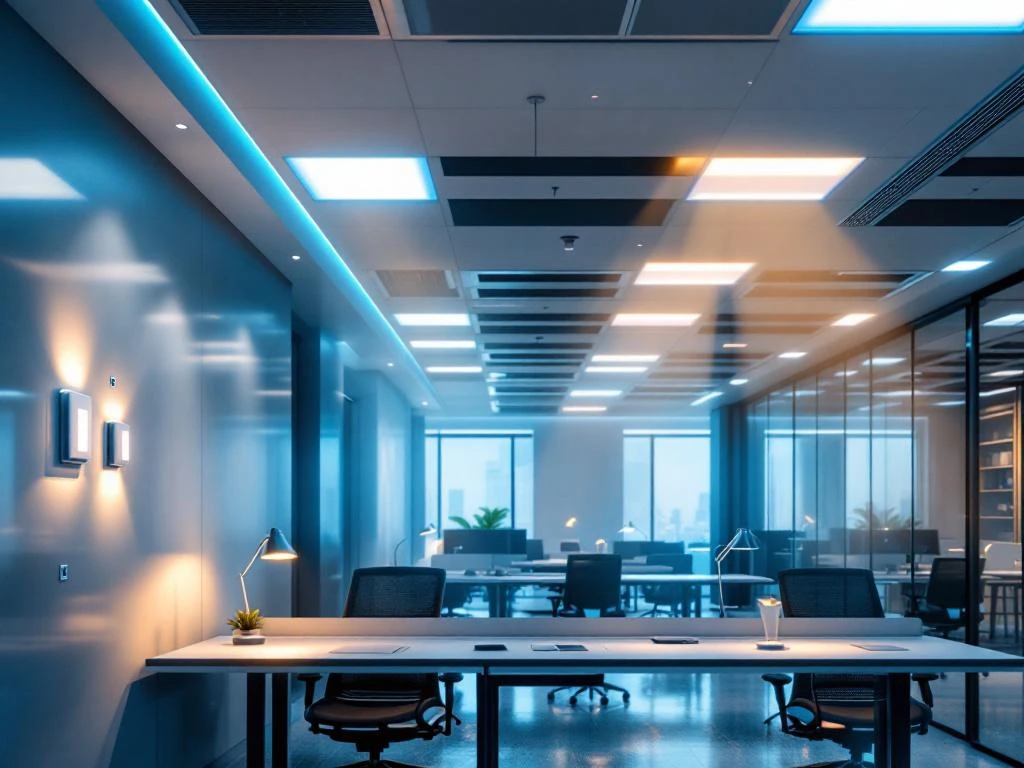
Smart lighting in a smart office uses sensors that detect movement, presence, and daylight to automatically adjust light intensity and color temperature. The system turns lights on and off based on occupancy, dims when there is sufficient natural light, and adjusts throughout the day. This saves energy, increases employee comfort, and supports natural biological rhythms for better productivity.
What is smart lighting and how does it differ from regular office lighting?
Smart lighting automatically adjusts brightness, color, and timing based on sensors and programmable settings. Traditional office lighting uses manual switches and fixed light levels that remain the same throughout the day.
The biggest difference lies in the intelligence of the system. Ordinary lighting turns on when you switch it on and stays on until you switch it off. Smart lighting thinks for itself, using sensors that register whether people are present, how much daylight is coming in, and what time of day it is.
This technology uses wireless connectivity to enable different lights and sensors to communicate with each other. You can manage the entire system via an app or a central control panel. Modern smart office solutions also integrate lighting with other building systems, such as heating and ventilation.
For offices, this means that workspaces are always optimally lit, without employees having to think about it themselves. The system learns patterns and adapts to the usage habits of the office.
Which sensors enable smart office lighting?
Motion sensors, daylight sensors, and presence detection form the basis of smart office lighting. Each type of sensor has a specific function that contributes to an intelligent lighting system.
Motion sensors detect when someone enters a room and automatically turn on the lights. They are ideal for hallways, restrooms, and meeting rooms that are not in constant use. These sensors use infrared technology that detects body heat.
Daylight sensors measure the amount of natural light entering through windows. The system adjusts the artificial lighting accordingly by dimming when there is a lot of sunlight and brightening when it gets darker outside. This keeps the light level constant throughout the day.
Presence detection goes beyond motion by also registering small movements, such as typing or breathing. These sensors prevent the light from turning off when someone is working quietly at their desk. They often use microwave technology for more accurate detection.
Some systems also have temperature sensors and sound sensors that provide additional information about room usage. All this data is combined to determine the most efficient lighting settings.
How does smart lighting save energy in offices?
Automatic dimming, switching on and off based on presence, and optimization of natural light reduce energy consumption by 30–60% compared to traditional office lighting.
The greatest potential for savings lies in preventing unnecessary lighting. Sensors ensure that lights are only on when and where they are needed. In large office buildings, many lights traditionally remain on throughout the working day, even in empty rooms.
Dimming functionality plays an important role in energy savings. When there is sufficient daylight, the lights dim automatically or even switch off completely. This happens gradually, so that employees are not inconvenienced.
LED technology combined with smart control maximizes energy savings. LEDs already consume 80% less energy than traditional incandescent bulbs, and smart control further optimizes this by producing only the amount of light needed.
Programmable schedules ensure that lighting is automatically turned off outside office hours. You can also set up zones so that only occupied areas of the office are lit during early or late working hours.
What are the benefits of smart lighting for employees?
Better support for circadian rhythms, reduced eye strain, and customizable lighting conditions significantly increase employee well-being and productivity.
Circadian lighting adjusts the color temperature throughout the day. In the morning, the system provides fresh, bluish light that helps you wake up. In the afternoon, the light becomes more neutral, and by the end of the workday, it becomes warmer and softer to support your natural biological clock.
Eye strain is reduced because the light level remains optimal at all times. Traditional lighting can be too bright when there is little daylight or too dim when the sun is shining. Smart systems maintain a comfortable contrast between the screen and the environment.
Personalization is made possible by individual workplace control. Employees can use an app to set their own lighting preferences within healthy limits. Some work better in brighter light, while others prefer a warmer tone.
The automatic nature of smart lighting reduces distractions. Employees do not need to get up to turn lights on or off or adjust the brightness. The system quietly ensures optimal conditions in the background.
How Wout Monseurs assists with smart office lighting
We seamlessly integrate smart lighting solutions into complete office designs. Our team analyzes your workspace and advises on the best sensors and lighting zones for optimal functionality and energy savings.
The installation is carried out in conjunction with other smart office elements, such as ergonomic furniture and climate control. We ensure that all systems work well together and are easy for your employees to operate.
After installation, we offer maintenance and support to ensure your smart lighting system performs optimally. We also help you adjust settings when your office layout changes or expands.
Would you like to know how smart lighting can improve your office? Contact us for a no-obligation consultation about your smart office options.
Frequently asked questions
What are the costs of smart lighting for an average office?
The investment for smart office lighting ranges from €50 to €150 per square meter, depending on the type of sensors and desired functionalities. These costs are usually recouped within 2-3 years through energy savings and increased employee productivity.
Can I install smart lighting in an existing office building?
Yes, smart lighting is ideal for existing offices. Most systems are wireless and can be installed without major renovations. However, it is important to have the existing electrical system checked by a specialist first.
How long does it take for employees to get used to smart lighting?
Most employees get used to smart lighting within 1-2 weeks because the system makes adjustments gradually. By setting the automatic functions to be a little more conservative during the first week, employees can slowly get used to the new lighting experiences.
What happens if the sensors fail?
Modern smart lighting systems have built-in backup functions that ensure normal lighting when sensors fail. The lights then switch to manual control or a default setting until the sensors are repaired.
Can employees override the automatic settings?
Yes, most systems offer employees the option to temporarily intervene manually via wall switches or an app. The system automatically returns to smart mode after a set time (usually 30-60 minutes).
Does smart lighting also work in rooms without windows?
Absolutely, smart lighting is particularly valuable in spaces without daylight. The system can simulate circadian lighting by adjusting color temperature and intensity based on the time of day, creating a natural light rhythm even in indoor spaces.
How easy is a smart lighting system to maintain?
Slimme LED-verlichting vereist minimaal onderhoud door de lange levensduur van LED’s (15-20 jaar). Het systeem monitort zichzelf en geeft meldingen wanneer lampen vervangen moeten worden. Sensoren hebben meestal een levensduur van 10-15 jaar.