

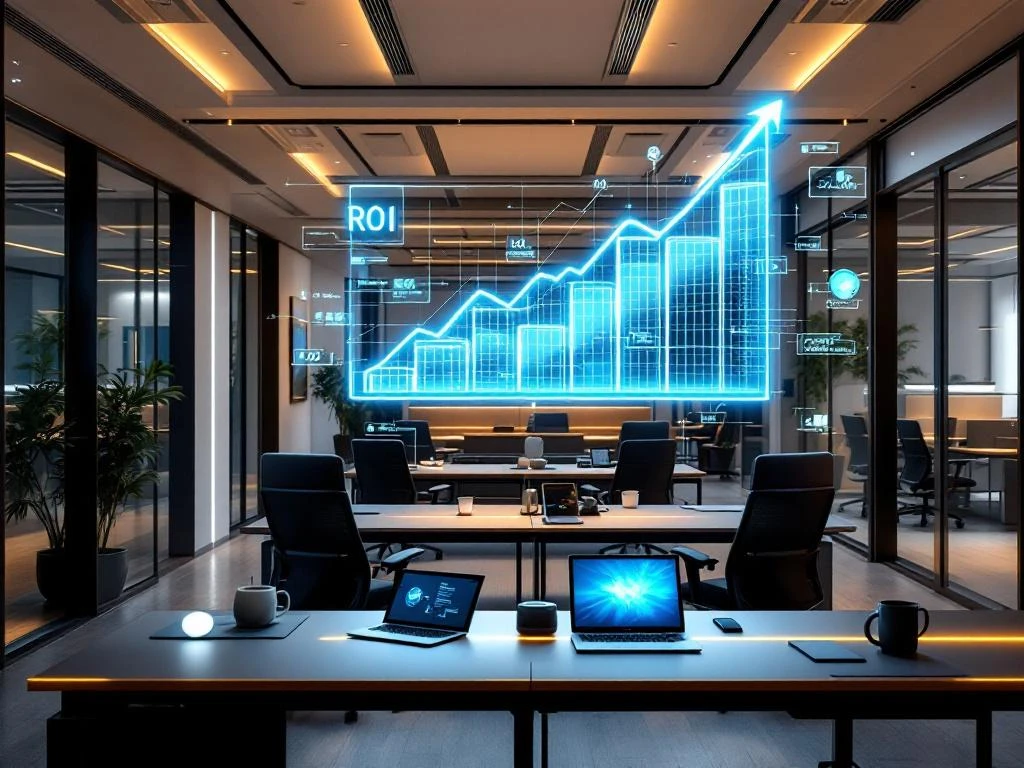
The ROI of a smart office varies between 15-30% per year due to cost savings on energy, space, and operational expenses, plus productivity improvements of 10-20%. The investment usually pays for itself within 2-4 years through lower energy costs, more efficient use of space, and increased employee satisfaction. The exact ROI depends on your current situation and which smart office technologies you implement.
What does ROI mean in the context of a smart office investment?
ROI on a smart office investment measures how much financial benefit you get for every dollar you invest in smart office technology. You calculate this by dividing the annual savings and productivity gains by the total investment costs and multiplying this by 100 to get a percentage.
When investing in smart offices, you look at different types of benefits. Direct benefits are measurable cost savings, such as lower energy bills thanks to smart lighting and climate control. Space optimization through flexible workspaces also saves on rental costs per square meter.
Indirect benefits are harder to measure, but often more valuable. Think of increased productivity due to ergonomic workplaces, reduced absenteeism due to better air quality, and higher employee satisfaction due to modern facilities. These factors reduce personnel costs and increase output.
For an accurate calculation, add up all annual savings and subtract any additional operating costs. This will give you the net annual benefits. Dividing this by your initial investment will give you a clear picture of your ROI percentage.
What costs can you save with a smart office?
Smart office technology primarily saves on energy costs, space costs, and IT support. Smart lighting and climate control reduce energy consumption by 20-40%, while flexible workspaces can reduce your space requirements by 15-30%. Automated systems also reduce the need for manual IT support.
Energy savings are achieved through sensors that automatically adjust lighting and heating based on occupancy and daylight. Smart thermostats learn usage patterns and optimize temperatures. This results in substantial savings on your monthly energy bill.
Space optimization works by collecting data on workplace usage. You discover which spaces are underutilized and can organize your office space more efficiently. Flexible workplaces mean you need less square footage for the same number of employees.
Operational savings come from automation. Smart systems for access control, meeting room management, and device management reduce administrative tasks. Your IT team spends less time on routine maintenance and can focus on strategic projects.
How does a smart office increase employee productivity?
Smart offices increase productivity by enabling ergonomic workplaces, automated processes, and better collaboration. Employees spend less time dealing with technical issues and can focus more on their core activities. Studies show productivity improvements of 10-20% in well-designed smart offices.
Ergonomic workstations automatically adapt to individual needs. Height-adjustable desks, smart lighting that adjusts to daylight, and climate control based on personal preferences ensure optimal working conditions. This reduces fatigue and increases focus.
Automated processes eliminate frustrations that hinder productivity. Think of meeting rooms that automatically switch on the right equipment, printers that schedule their own maintenance, and systems that help employees find available workspaces.
Better collaboration comes from technology that connects teams. Smart meeting rooms with seamless video integration, digital whiteboards that automatically share notes, and systems that help colleagues find each other encourage teamwork and innovation.
How long does it take to recoup a smart office investment?
Smart office investments usually pay for themselves within 2-4 years, depending on the scope of your project and your current situation. Smaller implementations, such as smart lighting, can be profitable within 1-2 years, while complete office revitalizations can take 3-5 years for a full return on investment.
The payback period depends on various factors. Your current energy costs determine how much you can save with smart systems. Offices with high energy and space costs see faster returns. The quality of your current IT infrastructure also influences the implementation costs and the speed of results.
Phased implementation helps you optimize your ROI. Start with projects that deliver quick results, such as smart lighting and climate control. Use the savings to finance further investments in more complex systems, such as workplace management and advanced automation.
Realistic expectations are important. In the first few months, you will mainly see cost savings, while productivity gains take time to develop. Employees need to get used to new systems and processes before the full productivity gains become apparent.
How Wout Monseurs helps maximize smart office ROI
We help companies maximize their smart office ROI through strategic planning tailored to your specific situation and goals. Our team first analyzes your current office costs and work processes to identify the most cost-effective improvements. We ensure the right technology integration that fits your budget and culture.
Our approach begins with a thorough analysis of your energy consumption, space utilization, and employee needs. We identify quick wins that deliver rapid results and build a phased plan for long-term investments. This ensures measurable results from the very first months.
We guide you through the entire process, from design to implementation and ongoing optimization. Our smart office team ensures that all systems work together seamlessly and that employees are well supported in the transition to new ways of working.
Want to know how a smart office can help your company save money and grow? Contact us for a no-obligation analysis of your options. We will show you what ROI is realistic for your situation and how we can achieve this together.
Frequently asked questions
Which smart office technologies offer the highest ROI?
Smart lighting and climate control usually deliver the highest ROI because they save energy immediately and are relatively inexpensive to implement. Workplace management systems and space utilization sensors follow in second place, especially in expensive office locations where space optimization saves a lot of money.
How do you measure the improvement in employee productivity after implementation?
Measure productivity improvements by comparing KPIs such as output per employee, time spent on non-productive tasks, and employee satisfaction scores before and after implementation. Absenteeism, staff turnover, and the time IT spends on support are also good indicators of the impact of your smart office.
What are the biggest pitfalls when calculating smart office ROI?
The biggest pitfalls are underestimating implementation costs, overestimating immediate savings, and ignoring change management costs. Many companies also forget the time and training required before employees can fully benefit from new systems, which means that ROI takes longer to achieve than expected.
Is a smart office investment also profitable for smaller offices?
Yes, but the approach must be different. Smaller offices benefit most from simple, scalable solutions such as smart lighting, thermostats, and basic workplace booking. The ROI is often higher per square meter because less complex infrastructure is required and implementation costs are lower.
What financing options are available for smart office investments?
Many suppliers offer lease arrangements or 'as-a-service' models that allow you to pay monthly instead of making a large upfront investment. Subsidies are also often available for energy-saving measures. These options lower the threshold and can accelerate your ROI through lower initial costs.
How can you prevent employees from resisting smart office changes?
Start by clearly communicating the benefits for employees themselves, not just for the company. Involve a group of ambassadors in the planning, offer extensive training, and implement gradually so that people can get used to it. Demonstrate concrete improvements such as better air quality or easier workplace booking to create support.
When is it time to upgrade or expand your smart office systems?
Upgrade when your systems no longer meet growing needs, when new technology offers significantly better ROI, or when maintenance becomes more expensive than replacement. Monitor your data: if space utilization or energy consumption increases again despite your systems, it's time for expansion or optimization.