

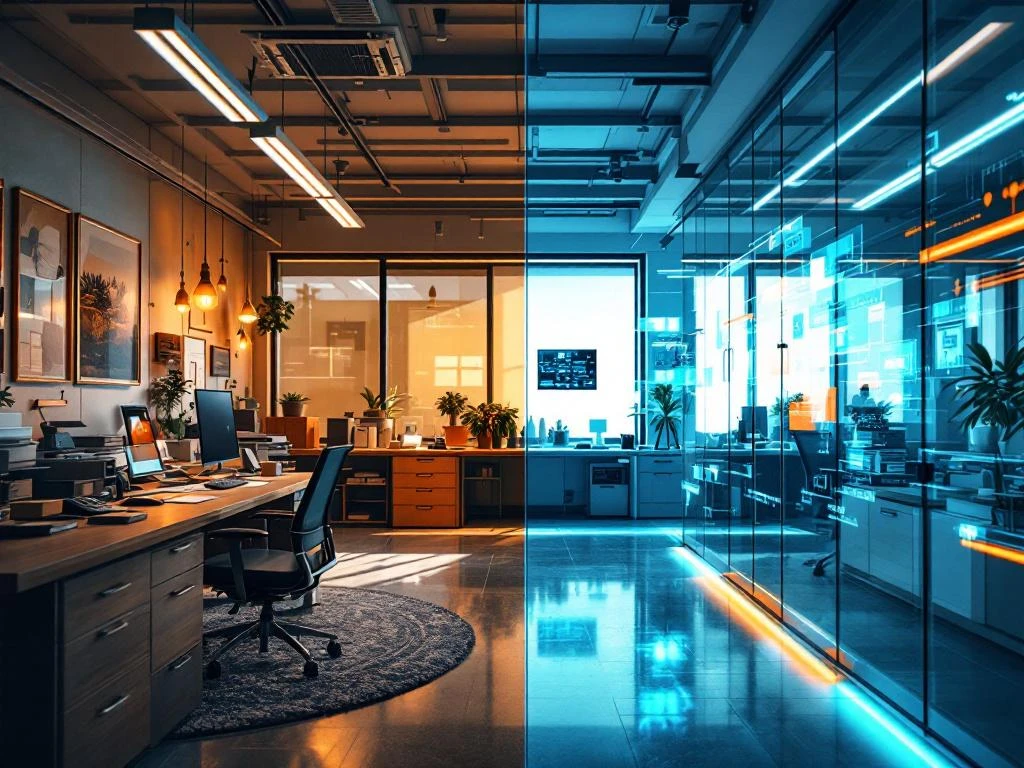
A smart office differs from a traditional office in that it integrates advanced technology that automatically responds to user needs. Whereas traditional offices require manual control of lighting, climate, and access, smart offices use sensors and data analysis to automate these processes. This results in a more efficient, comfortable, and cost-effective working environment that adapts to your work patterns.
What actually makes a smart office 'smart'?
A smart office becomes "smart" through integrated technology that makes independent decisions based on data and user behavior. IoT sensors continuously measure movement, temperature, air quality, and noise levels, while automation systems use this information to adjust the working environment in real time.
The smart building management systems connect all technological components with each other. Think of lighting that automatically dims when there is sufficient daylight, climate control systems that anticipate occupancy rates, and meeting rooms that reserve themselves when you walk in. These systems learn from your work patterns and adapt accordingly.
Data analysis is the brain of the smart office. All sensors collect information about space usage, energy consumption, and employee behavior. This data is analyzed to identify patterns and make predictions, allowing the office to proactively respond to your needs before you even think of them.
How does the daily work experience differ between the two types of offices?
In a traditional office, you manually switch on lights, adjust the thermostat yourself, and reserve meeting rooms via a system. In a smart office, all of this happens automatically: access control via badges or facial recognition, lighting that adjusts to your presence, and climate control that responds to occupancy.
You notice the practical differences immediately. Traditional offices often have cold or warm spots, meeting rooms that turn out to be occupied despite reservations, and lighting that stays at the same level all day long. Smart offices adapt continuously: the temperature rises before you arrive, meeting rooms are automatically released if no one shows up, and lighting follows the daylight.
Noise levels in smart offices are actively managed by systems that adjust background noise to the level of activity. Collaboration is improved because you can find colleagues via location apps and available workspaces are displayed in real time. This saves search time and reduces the frustration often experienced in traditional offices.
What advantages does a smart office offer over traditional offices?
Increased productivity is achieved because smart offices minimize distractions and create optimal working conditions. Automatic adjustments to lighting, temperature, and noise ensure that you can concentrate on your work rather than your surroundings.
Energy savings are a direct benefit: smart offices use 20–30% less energy by only heating, lighting, and ventilating spaces that are actually in use. Sensors detect when spaces are empty and automatically switch off systems.
Employee satisfaction increases as frustrations disappear. No more searching for available workspaces, manually adjusting the climate, or double-booked meeting rooms. Flexibility increases because you can work from any location thanks to cloud-based systems and mobile apps.
Data insights help with decision-making about office layout and facilities. You can see which spaces are popular, when peak hours occur, and where bottlenecks arise. Cost optimization follows automatically through more efficient use of space and energy.
What are the costs and challenges of transitioning to a smart office?
The investment costs for a smart office are considerably higher than for traditional office design. IoT sensors, automation systems, and software require an initial investment that is 30–50% higher than for standard office design, depending on the desired functionalities.
Implementation challenges include integrating different systems and adapting existing infrastructure. Older buildings often have outdated cabling and climate control systems that must first be modernized before smart technology can be installed.
Staff training is necessary because employees need to get used to new systems and apps. Cybersecurity is becoming more complex due to the many connected devices, which requires additional security measures and monitoring. Maintenance is becoming more technical and requires specialist knowledge.
The long-term benefits often outweigh the costs: lower energy bills, increased productivity, and better space utilization usually result in a positive return on investment within three to five years. The key lies in realistic planning and phased implementation.
How Wout Monseurs assists in the transition to a smart office
We guide you from start to finish in realizing your smart office. Our approach begins with a thorough analysis of your current situation and work processes, so that we know exactly which smart solutions offer the most added value for your organization.
The design process combines our sixty years of experience in office design with the latest smart office technologies. We work with reliable suppliers of IoT systems and automation solutions to create an integrated whole that functions seamlessly.
After implementation, we provide support and maintenance to ensure that your smart office continues to perform optimally. Our local involvement means that we can respond quickly if adjustments are needed.
Want to know how a smart office can transform your workplace? Contact us for a no-obligation analysis of the possibilities within your organization.
Frequently asked questions
How long does it take to convert an existing office into a smart office?
The implementation time varies from 3-8 months, depending on the size of the office and the desired functionalities. Simple upgrades such as smart lighting and thermostats can be installed within a few weeks, while complete integration of IoT sensors and automation systems takes more time. We plan the work in such a way that daily operations are disrupted as little as possible.
What happens if the technology fails—can I still work normally?
Yes, smart offices are designed with backup systems and manual override options. In the event of a system failure, lighting, climate control, and access control automatically switch to standard mode so you can continue working as usual. Most systems have local backups that function independently of internet connections.
Is my company data secure in a smart office with all those sensors?
Modern smart office systems use enterprise-grade security with end-to-end encryption and local data processing. Sensors only collect anonymous usage data (movement, temperature) and no personal information. We implement security protocols that comply with GDPR guidelines and isolate smart office networks from business-critical systems.
Can we introduce the smart office functionalities in phases to spread the costs?
Absolutely, phased implementation is often the smartest approach. We usually start with basic automation such as smart lighting and climate control, followed by more advanced features such as room reservation and data analytics. This spreads the investment over several years and gives employees time to get used to each new system.
How do you train employees to use smart office technology effectively?
We offer comprehensive training through hands-on workshops and digital manuals. Most smart office features are designed to be intuitive and work automatically in the background. For features that require active interaction, such as mobile apps for workplace reservations, we organize practical sessions and offer ongoing support during the first few months.
Which smart office features deliver measurable returns the fastest?
Energy-saving systems such as smart lighting and climate control show measurable cost reductions of 20-30% within 6-12 months. Space optimization through occupancy sensors can reduce rental costs through more efficient use of space. Productivity gains through improved working conditions are noticeable within a few weeks, but financial returns are usually visible after 2-3 years.