

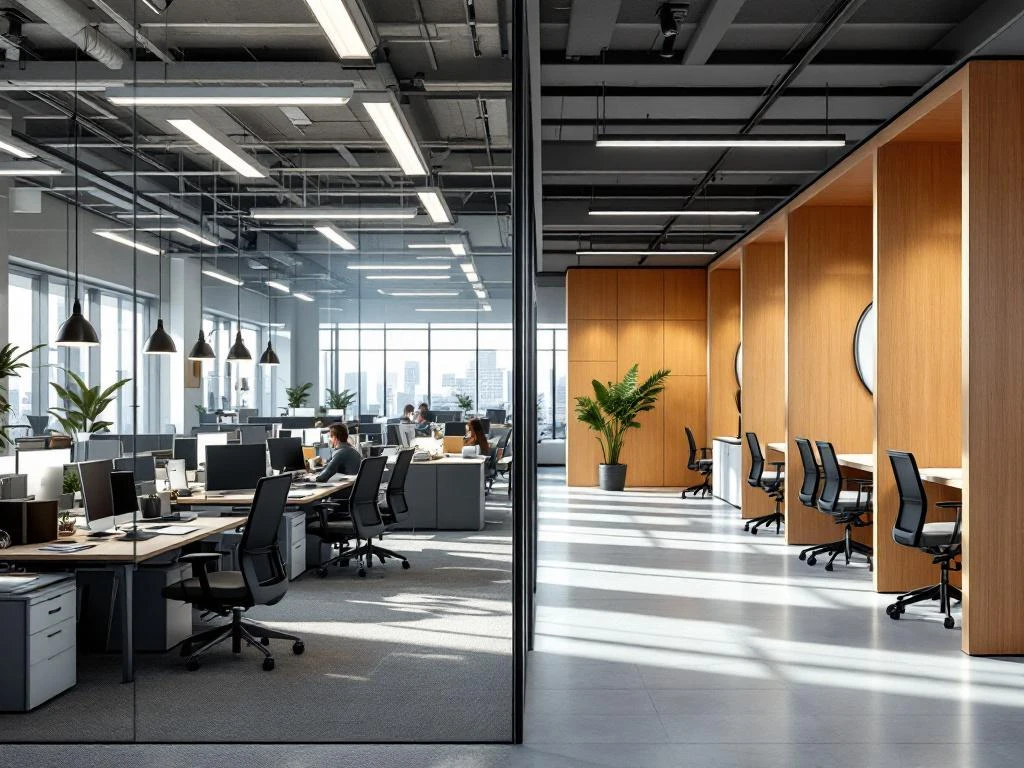
Privacy in open-plan offices can be created by cleverly combining different solutions. Acoustic panels and desk screens reduce noise and visual distractions, while phone booths and quiet zones provide space for concentrated work. Modular furniture systems and planters help to demarcate personal workspaces without completely removing the open feel.
Why has privacy become so important in open-plan offices?
Privacy in open-plan offices is becoming increasingly important because employees need concentration and peace and quiet to remain productive. Open-plan offices often cause distractions due to noise, movement, and the feeling of being constantly visible. This leads to stress, reduced focus, and lower work performance.
Modern employees perform various types of tasks that require different levels of concentration. Phone calls, video calls, and deep thinking all have different spatial requirements. Without privacy solutions, employees quickly become overstimulated and less motivated.
Companies are discovering that investing in privacy improves the working atmosphere and reduces absenteeism. Employees feel more comfortable when they have control over their immediate working environment. This not only increases productivity, but also employee satisfaction and loyalty to the company.
What types of privacy can you distinguish in office environments?
In office environments, there are four main types of privacy: acoustic privacy (protection from noise), visual privacy (limited visibility), spatial privacy (personal workspace), and digital privacy (screen protection). Each type requires specific solutions and has different effects on employee well-being.
Acoustic privacy protects against disruptive noises from colleagues, equipment, and office activities. This type of privacy is often the most urgent, because noise pollution directly disrupts concentration.
Visual privacy ensures that employees are not constantly working in full view of others. This reduces the feeling of constant observation and helps to create a more relaxed working atmosphere.
Spatial privacy is about having your own defined area where employees can put their belongings and retreat. Digital privacy protects sensitive information on screens from prying eyes of passers-by.
How do you create acoustic privacy without losing openness?
Acoustic privacy can be created by strategically placing sound-absorbing materials and dividing spaces functionally. Acoustic panels on walls and ceilings, sound-absorbing partitions, and soft materials such as carpets and curtains effectively absorb sound. Phone booths and quiet zones provide places for conversations and concentrated work.
The smart placement of workstations also helps enormously. Move noisy activities such as printers and coffee corners away from quiet work areas. Create different zones for different activities: a collaborative zone for teamwork, a quiet zone for individual work, and a social zone for informal conversations.
Masking noise with background music or white noise can also help. Just make sure it doesn't become distracting. Plant walls act as natural sound absorbers and add greenery to the workplace at the same time.
Which furniture solutions help create visual privacy?
Visual privacy is created by partition walls, desk screens, modular furniture systems, and planters that interrupt sightlines without completely closing off the office. These solutions give employees a sense of personal space while retaining the benefits of an open office.
Desk screens are a simple and flexible solution. They can be attached to existing desks and are available in various heights and materials. For more privacy, choose taller panels; for maintaining openness, lower variants will suffice.
Modular furniture systems offer the most flexibility. You can adapt and reorganize workspaces as needed without major renovations. Planters on wheels combine privacy with greenery and can be easily moved when the layout changes.
Tall cabinets and bookcases can also serve as room dividers. They not only offer privacy, but also storage space, which is especially useful in compact offices.
How Wout Monseurs assists with project design
Wout Monseurs assists companies in designing offices that cleverly combine privacy with openness through well-thought-out project design. We create 3D designs that allow you to see exactly how privacy solutions will work in your office. Our expertise in ergonomic design ensures that workspaces not only feel private, but are also healthy and productive.
We work with high-quality brands such as Interstuhl, Voortman, and Gispen to create customized solutions that perfectly match your corporate culture. From acoustic panels to modular furniture systems, we take care of the entire process from design to installation.
Would you like to know how we can transform your office into a space that perfectly combines privacy and collaboration? Contact us for a no-obligation consultation about the possibilities for your office environment.
Frequently asked questions
How do I determine which privacy solutions are best suited to my office?
Start by identifying the biggest privacy issues in your office: is it mainly noise pollution, visual distractions, or a lack of personal space? Observe how employees behave for a week and where most disturbances occur. Based on this, you can set priorities and start with the most urgent solutions, such as acoustic panels for noise pollution or desk screens for excessive visual distractions.
What are the costs of implementing privacy solutions in an open-plan office?
The costs vary greatly depending on the solutions chosen and the size of the office. Simple desk screens cost between €100-400 each, while phone booths can cost €3,000-8,000. Acoustic panels cost between €50-200 per m². A phased approach helps to spread the costs: start with the most cost-effective solutions such as desk screens and planters, and invest in more expensive items such as phone booths later on.
Can privacy solutions hinder collaboration and communication between colleagues?
Well-implemented privacy solutions actually improve collaboration by giving employees the choice of when they are available for interaction. Consciously create different zones: quiet zones for concentrated work and collaborative zones for teamwork. Use semi-transparent partitions or lower panels that offer privacy but still allow eye contact. It's about balance, not complete separation.
How do I maintain acoustic panels and other privacy solutions?
Most acoustic panels are dust-repellent and can be cleaned with a vacuum cleaner or a slightly damp cloth. Check monthly to ensure that the panels are still securely attached and that there is no damage. Planters need to be watered and pruned regularly. Desk screens can be cleaned with standard office cleaning products. Modular systems should be checked annually for wear and tear on connections and casters.
What should I do if employees complain that the office feels too closed off after installing privacy solutions?
This is a common adjustment issue that usually resolves within 2-4 weeks. Ensure adequate lighting and use light colors for partition walls to maintain an open feel. Consider semi-transparent materials or panels with openings. Involve employees in choosing solutions and explain why privacy is important for their productivity and well-being.
Can I install privacy solutions myself, or do I need professional help?
Simple solutions such as desk screens, planters on wheels, and freestanding acoustic panels can often be installed by yourself. For wall-mounted panels, phone booths, and modular systems, professional installation is recommended for safety and warranty reasons. Electrical installations for phone booths always require a certified installer. Plan the installation outside office hours to minimize disruption to work.
How can I measure whether the privacy solutions are actually working?
Meet het succes door voor en na implementatie werknemerstevredenheid te enquêteren, met focus op concentratie, stress en productiviteit. Gebruik geluidsmeting apps om akoestische verbetering te meten (streef naar <50 dB in stille zones). Monitor ziekteverzuim en productiviteitsindicatoren. Observeer gedragsveranderingen: gebruiken werknemers de nieuwe faciliteiten en lijken ze meer ontspannen? Evalueer na 3-6 maanden en pas zo nodig bij.