

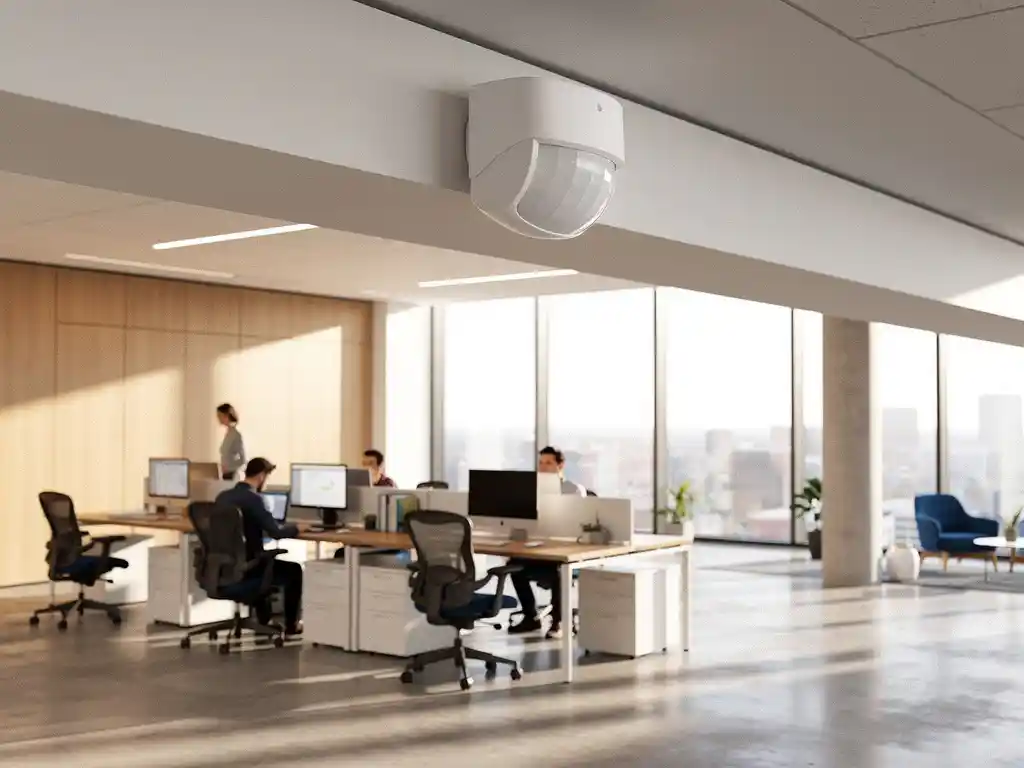
Smart office sensors are revolutionizing the modern workplace by providing insights into space utilization, energy consumption, and employee comfort. For companies considering investing in the implementation costs of a smart office, it is essential to understand exactly what this technology entails and what financial investment is involved.
The cost of smart office sensors varies widely depending on the type of sensor, its functionality, and the scope of the implementation. From simple motion sensors to advanced multi-sensor systems that monitor air quality, temperature, and noise levels, each system has its own price range and offers unique value to the organization.
What exactly are smart office sensors?
Smart office sensors are IoT devices that monitor various parameters in office environments and collect data on space utilization, air quality, temperature, light intensity, and noise levels. These sensors communicate wirelessly with a central system that analyzes the collected data and provides insights for optimizing the workplace.
The most common types of smart office sensors include motion sensors for monitoring workplace occupancy, air quality sensors that measure CO2 levels, temperature and humidity sensors for climate control, and noise sensors that monitor acoustic conditions. More advanced systems combine multiple sensor functions into a single device.
These sensors are part of a larger smart office ecosystem that automates workspace management. For example, they can automatically adjust lighting based on occupancy, optimize climate control systems when rooms are empty, or help employees find available workspaces through a desk booking system.
How much do smart office sensors cost each?
The cost of smart office sensors ranges from €50 for basic motion sensors to €500 for multifunctional sensors with advanced analytics capabilities. Simple occupancy sensors cost an average of €75–150 each, while advanced air quality sensors can cost €200–400.
For a standard office environment, the following price ranges are typical:
- Motion and occupancy sensors: €50–150 per sensor
- Air quality sensors (CO2, VOC): €150–300 per sensor
- Multifunctional sensors: €250–500 per sensor
- Noise level sensors: €100–250 per sensor
- Temperature and humidity sensors: €75–200 per sensor
Premium brands and sensors with advanced features—such as battery life lasting several years, higher accuracy, or extensive connectivity options—are at the top end of these price ranges. Bulk purchases can yield significant discounts, especially for deployments involving more than 50 sensors.
What additional costs are involved in implementation?
In addition to sensor costs, organizations must factor in installation costs (€25–75 per sensor), software licenses (€2–10 per sensor per month), network infrastructure, and any consulting services required for optimal placement. Total implementation costs often amount to 150–200% of the sensor costs.
The main additional costs are:
- Installation and configuration: €25–75 per sensor
- Software platform and dashboard: €2–10 per sensor per month
- Network infrastructure: €500–2,000 for gateways and routers
- Consulting and project management: €1,000–5,000, depending on the scope of the project
- Training and support: €500–2,000 for employee training
For an office with 100 workstations and 80 sensors, this represents an initial investment of €15,000–25,000 for hardware and implementation, plus €160–800 per month in software costs. Maintenance and battery replacement add another 5–10% of the initial sensor costs annually.
Organizations that opt for a complete office fit-out can often take advantage of package deals that integrate sensors into the overall design, which can lead to cost savings.
What is the return on investment for office sensors?
The ROI of smart office sensors averages between 150% and 300% over three years, primarily due to energy savings (20–40%), optimized space utilization (15–25% less floor space required), and increased employee productivity. The payback period is typically 12–24 months.
The main financial benefits are:
- Energy savings: 20–40% reduction in electricity and heating costs
- Space optimization: 15–25% more efficient use of space through insight into occupancy patterns
- Maintenance savings: 10–20% reduction in facility costs through predictive maintenance
- Productivity improvement: 5–15% increase due to improved air quality and comfort
For an office with annual energy costs of €50,000, sensors can save €10,000–20,000 per year. With rental costs of €300 per square meter, a 20% reduction in space can save €60,000 annually for a 1,000 m² office. These savings often far exceed the initial investment and ongoing costs.
In addition, sensors provide valuable data for strategic decisions regarding office layout, flexible work arrangements, and future space requirements, further enhancing long-term value.
How Wout Monseurs Helps with Smart Office Implementation
We offer a comprehensive approach to smart office implementation, from consulting and design to installation and maintenance. As an experienced project designer, we seamlessly integrate smart sensor technology with ergonomic office design to achieve optimal workplace results.
Our smart office services include:
- Free consultation and space analysis for optimal sensor placement
- Integration of sensors into the overall office design
- Professional installation and configuration by our in-house technical support team
- Training employees in the use of smart office systems
- Ongoing maintenance and support through our service contract
With over 60 years of experience in office design, we understand how technology and furniture work together to create a productive work environment. Contact us for a no-obligation consultation on the possibilities of smart office sensors in your organization.
Frequently asked questions
How do I determine how many sensors I need for my office?
The number of sensors depends on your objectives and office layout. For occupancy monitoring, you should plan for an average of 1 sensor per 2–3 workstations; for air quality, 1 sensor per 50–100 m²; and for general monitoring, 1 multifunctional sensor per room or zone. A professional space analysis can help determine the optimal sensor density for your specific situation.
Can smart office sensors also be installed in existing office buildings?
Yes, modern smart office sensors are specifically designed for retrofit installations in existing buildings. Most sensors are wireless and have a battery life of 3–7 years, eliminating the need for wiring. Installation can usually be completed within a few days without major renovations or disruption to daily operations.
What happens to the data collected by the sensors, and what about privacy?
Smart office sensors collect anonymous, aggregated data on space usage and environmental conditions, not on individual people. The data is securely stored in accordance with GDPR guidelines and used to generate reports on occupancy patterns, energy consumption, and air quality. Employees cannot be tracked or identified individually.
How long will it take before I see a return on my investment in office sensors?
Initial insights are visible immediately after installation, but meaningful trends and opportunities for optimization become apparent after 2–3 months of data collection. Financial savings from energy optimization are usually measurable within 3–6 months, while space optimization and strategic decisions often require 6–12 months of data to draw reliable conclusions.
What if the sensors malfunction or the battery runs out?
High-quality sensors have a low failure rate (less than 2%) and batteries last 3–7 years. The system automatically alerts you when battery levels are low or if a malfunction occurs. Replacement is easy: sensors attach magnetically or have an adhesive backing. A good service contract covers battery replacement and any repairs, ensuring your system always operates at peak performance.
Can smart office sensors integrate with our existing building management systems?
Ja, moderne sensorsystemen bieden standaard API’s en integraties met populaire gebouwbeheersystemen (BMS), HVAC-systemen en facilitaire software. Dit maakt automatische klimaatregeling, energiebesparing en integratie met bestaande workflows mogelijk. Bij implementatie wordt compatibiliteit altijd vooraf gecontroleerd en getest.
Is it possible to start small and expand the system later?
Absolutely, a phased approach is often sensible and cost-effective. For example, start by installing occupancy sensors in a pilot area to gain experience and demonstrate ROI. The system has a modular design, allowing you to easily add sensors or upgrade to more advanced features later on without replacing the existing infrastructure.