

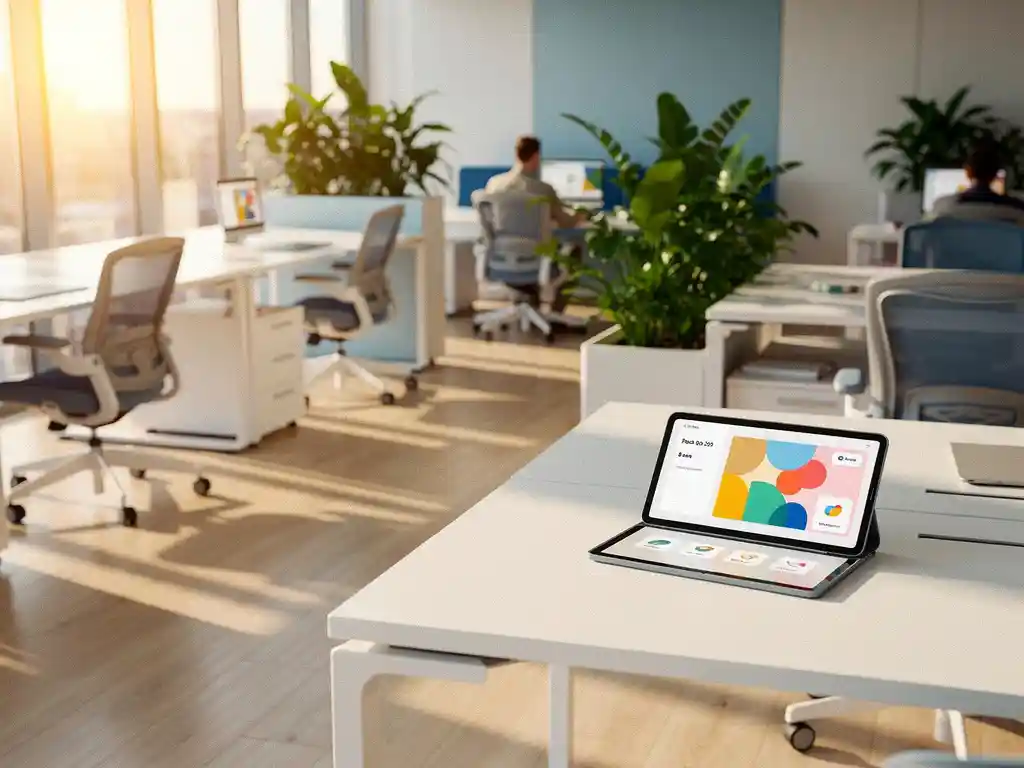
Modern offices face a major challenge: how can they make the most of their workspace while also enabling flexible working? With the rise of hybrid work and flexible workspaces, traditional fixed desks are no longer the norm. This is where desk booking systems come in as a smart solution for space management and workspace optimization.
An office desk booking system allows employees to easily reserve workstations and meeting rooms via a smartphone or computer. This technology not only helps organizations make efficient use of office space, but also solves numerous practical problems arising from modern work patterns.
What are desk booking systems, and why are they important?
Desk booking systems are digital platforms that allow employees to reserve workstations, meeting rooms, and other office spaces via an app or web portal. These systems make it possible to book a workstation with a single click and provide real-time insight into room availability.
The importance of these systems lies in changing work patterns. Whereas employees used to have a fixed workstation, they now work in a hybrid model: sometimes at home, sometimes at the office. This means that workstations are no longer permanently occupied but can be used flexibly. A desk booking system ensures that this flexibility is managed in an organized and efficient manner.
Modern desk booking tools often offer additional features, such as automatic desk assignments based on personal preferences, integration with calendars, and even links to climate control systems. This makes the work experience not only more flexible, but also more comfortable and personalized.
What space-related issues do desk booking systems solve?
Desk booking systems address three main issues: underutilization of office space, the time spent searching for available workstations, and the inefficient distribution of employees throughout the office. These issues cost organizations both money and productivity.
The biggest problem is underutilization. Many offices have workstations that are used only 30–40% of the time, even though organizations are paying the full rent and energy costs. A desk booking system provides insight into actual occupancy rates and makes it possible to use space more efficiently.
A second issue is the time spent searching. Employees often wander around looking for an available workspace, especially in open-plan offices. This not only disrupts their own productivity, but also that of their colleagues. With a reservation system, employees know in advance where they can work.
Finally, these systems help ensure an even distribution of people. Without a reservation system, hotspots often form where everyone wants to sit, while other parts of the office remain empty. Smart office technology can direct employees to less crowded areas, resulting in a more balanced distribution and a quieter work environment.
How do desk booking systems help manage hybrid teams?
Desk booking systems simplify hybrid team management by providing predictability regarding who is in the office and when, helping team members find each other, and facilitating collaboration by enabling shared bookings.
For managers, the biggest benefit is having a clear overview. They can use the system to see which team members are scheduled to be in the office on which days. This helps with scheduling team meetings, brainstorming sessions, and other activities that require face-to-face interaction. No more surprises about who is or isn’t present.
The system also encourages spontaneous collaboration. Colleagues can see where their teammates are and choose to book seats near each other. Some systems even have a “buddy feature” that automatically seats you near specific colleagues.
For project teams, a desk booking system makes it possible to reserve spaces collectively. For example, an entire team can reserve a day together in a specific zone, complete with a dedicated meeting room. This fosters focus and enhances team dynamics, even in a flexible work environment.
What cost savings do desk booking systems offer?
Desk booking systems generate cost savings by increasing space efficiency, optimizing energy consumption, and reducing facility costs. Organizations can save up to 30% on real estate costs through more efficient use of space.
The greatest savings come from optimizing real estate. By gaining insight into actual occupancy rates, organizations can determine whether they need less office space. If it turns out that workstations are occupied only 40% of the time on average, an organization may consider downsizing or subleasing part of the space.
Energy savings are achieved through smart building management. The system can automatically control climate control and lighting based on reservations. Areas that are not reserved do not need to be heated or lit. This can reduce energy costs by 20–30%.
Facility costs also decrease thanks to better planning. Cleaning services only need to clean occupied areas, coffee supplies can be tailored to the expected number of employees, and security can be optimized. These savings may seem small, but they add up to substantial amounts over the course of a year.
How do desk booking systems improve the employee experience?
Desk booking systems enhance the employee experience by offering choice and control over workspaces, eliminating wait times and frustration, and accommodating personal preferences such as desk height and environmental settings.
The main benefit is autonomy. Employees can choose where they want to work: by the window for natural light, in a quiet corner for focused work, or in a lively area to boost their energy. This freedom of choice increases job satisfaction and a sense of control over one’s own workday.
Modern systems remember personal preferences and can automatically adjust workstations. This includes the correct desk height, monitor angle, and even temperature preferences. This saves time and ensures that employees can be productive right away, without having to adjust their workstations first.
An additional benefit is social connection. The system can show where colleagues are located, which encourages spontaneous interactions and collaboration. Combined with a clean desk policy, this creates a professional, organized work environment without making workspaces feel impersonal, thanks to the option of personal, bookable lockers.
How Wout Monseurs helps with desk booking systems
At Wout Monseurs, we integrate desk-booking technology as part of our Smart Office solutions. With over 60 years of experience in office design, we combine traditional expertise with modern technology to deliver comprehensive workplace solutions.
Our approach includes:
- Implementation of user-friendly desk booking tools that integrate with existing systems
- Automatic desktop settings based on users' personal preferences
- Integration with smart building management systems for energy efficiency
- Consulting on optimal office layouts for flexible working
- Integration with bookable lockers and clean desk policies
As a full-service project design firm, we ensure that the technology integrates seamlessly with your office design and corporate culture—from the initial design through to full implementation and employee training. Would you like to learn how a desk booking system can transform your office? Contact us for a no-obligation consultation about the possibilities.
Frequently asked questions
How long does it take to implement a desk booking system?
Implementation typically takes 2–4 weeks, depending on the size of your office and the integrations you require. This includes software installation, integration with existing systems, employee training, and a testing period. We ensure a phased rollout to minimize disruption to daily operations.
What happens if employees don't use their reserved workstations?
Modern desk booking systems feature automatic "no-show" detection via sensors or check-in functions. If a desk remains unused 30–60 minutes after the reserved time, it automatically becomes available again. This prevents desks from remaining occupied unnecessarily and maximizes efficiency.
Can older employees also easily use a desk booking system?
Yes, modern desk booking systems are designed for ease of use with intuitive interfaces. We offer comprehensive training and support, including step-by-step guides. Many systems also feature a simple "walk-up" function that allows employees to claim a workspace on the spot without booking in advance.
How can you prevent popular workspaces from always being reserved by the same people?
This is addressed through smart algorithms that ensure fair distribution, such as rotation systems for premium locations and limits on consecutive bookings of the same workspace. Some systems use a lottery system for highly sought-after spaces or offer alternative locations with similar amenities.
What data does a desk booking system collect, and how is privacy protected?
The system collects only workspace-related data, such as reservation times, location preferences, and occupancy rates. Personal data is handled in accordance with GDPR regulations, with full transparency regarding data usage. Employees always have access to their own data and can edit or delete it.
What is the cost of a desk booking system, and how long does it take to pay for itself?
The investment depends on the size of your office and the features you need, but typically starts at around €5–15 per user per month. Thanks to space savings of 20–30% and energy savings, the system often pays for itself within 12–18 months. We always calculate the ROI based on your specific situation.
Can a desk booking system still work if employees come into the office on the spur of the moment?
Absolutely. In addition to advance reservations, most systems support "walk-in" reservations, allowing employees to claim available workstations on the spot. Real-time overviews immediately show which stations are available, and some systems even feature LED indicators at each workstation for instant visibility.