

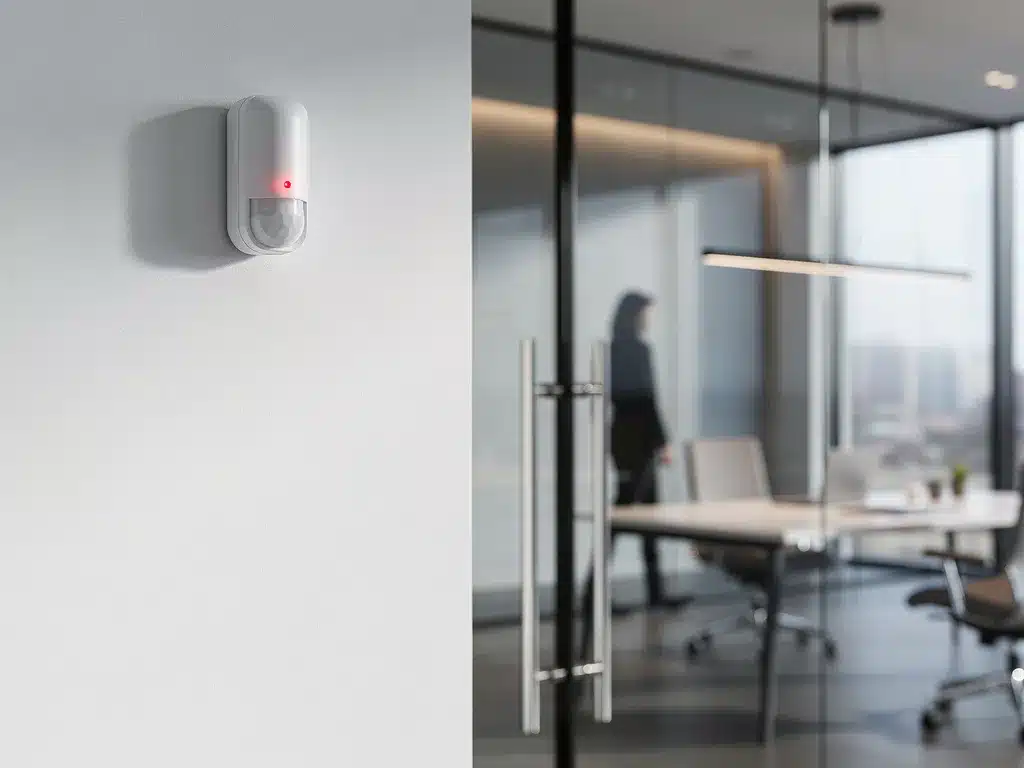
Modern offices require advanced security solutions to prevent unauthorized access and provide employees with a safe working environment. Smart sensors in the office environment play a crucial role in this by detecting various forms of unwanted activity and automatically triggering an alarm.
From motion detection to door and window monitoring: the right combination of sensors creates an invisible safety net around your office space. This technology integrates seamlessly with modern Smart Office systems and provides real-time insight into what’s happening in your building, both during and outside of business hours.
Which sensors detect motion in office spaces?
Motion sensors for offices primarily use PIR (passive infrared) technology, microwave sensors, and dual-detection technology to detect unauthorized movement. These sensors detect changes in temperature, movement patterns, and vibrations within the room.
PIR sensors are the most commonly used type for indoor applications. They respond to body heat and movement, allowing them to distinguish between normal temperature fluctuations and human presence. These sensors have a detection range of 8 to 12 meters and a detection angle of 110 degrees, enabling them to effectively monitor large office spaces.
Microwave sensors emit high-frequency radio waves that bounce off moving objects. They are more sensitive than PIR sensors and can detect movement through thin walls and glass surfaces. This makes them ideal for offices with many glass walls or open workspaces.
Dual detection sensors combine PIR and microwave technology to minimize false alarms. Both technologies must detect motion simultaneously before an alarm is triggered, which significantly increases reliability.
How do door and window sensors work for office security?
Door and window sensors consist of two parts: a magnet and a switch that trigger an alarm as soon as the magnetic connection is broken. These sensors immediately detect when a door or window is opened, even with the slightest movement.
The magnet is attached to the moving part (door or window sash), while the switch is mounted on the fixed frame. When the door or window is closed, the magnet holds the switch in the “safe” position. When it is opened, this magnetic connection is broken and a signal is immediately sent to the security system.
Modern door and window sensors are equipped with wireless technology and can communicate via Wi-Fi, Zigbee, or Z-Wave protocols. This simplifies installation since no wiring is required, and they can be easily integrated into existing Smart Office systems.
For offices, there are also special sensors available that distinguish between normal opening (by an authorized person) and forced entry. These sensors detect vibrations and sudden movements that indicate attempted break-ins.
What is the difference between indoor and outdoor sensors?
Indoor sensors are designed for use in protected environments and are intended for motion detection in office spaces, while outdoor sensors are weatherproof and built for perimeter surveillance around the building. The main difference lies in their construction, sensitivity, and detection methods.
Indoor sensors are more sensitive because they do not need to compensate for weather conditions such as wind, rain, or temperature fluctuations. They are typically more compact and discreet in design to blend in with office decor. Indoor PIR sensors have a detection range of 8 to 15 meters and are optimized to detect human body heat.
Outdoor sensors, on the other hand, must be able to withstand extreme weather conditions and are equipped with algorithms to prevent false alarms caused by animals, falling leaves, or moving branches. They often use dual detection technology and have a longer detection range of 15 to 30 meters. These sensors are certified to IP65 or IP67 standards for water and dust resistance.
For office security, a combination of sensors is often used: outdoor sensors for early detection along the perimeter and indoor sensors for precise location tracking within the building. This layered approach maximizes the effectiveness of the security system.
Which smart sensors integrate with office security systems?
Smart sensors that integrate with office security systems include IoT motion detectors, smart door/window contacts, glass break sensors, vibration sensors, and environmental sensors that monitor temperature, humidity, and air quality. These sensors communicate via wireless protocols and can be controlled through smartphone apps.
IoT motion detectors offer advanced features such as person recognition, activity analysis, and integration with lighting and climate control systems. They can distinguish between authorized personnel and unknown individuals using facial recognition or badge detection.
Smart door and window sensors send real-time notifications to security personnel and can be integrated with access control systems. They not only detect when a door or window is opened, but also track how long they remain open.
Glass break sensors detect the specific sound frequency of breaking glass and can be combined with vibration sensors that detect mechanical break-in attempts. These sensors are particularly effective for offices with large glass surfaces.
Environmental sensors play a supporting role by detecting unusual changes in temperature, humidity, or air quality that may indicate a fire hazard or other safety risks.
How do you choose the right sensors for your office?
The choice of sensors for office security depends on the size of your office, the number of entry points, the presence of valuable equipment, and your budget. Start with a risk assessment to determine which areas have the highest security priority.
For small offices (up to 100 m²), a combination of PIR motion sensors at the main entrance and door/window contacts at all access points is usually sufficient. Ensure there is at least one sensor per 25 m² of floor space for optimal coverage.
Medium-sized offices (100–500 m²) require a layered system with perimeter sensors, motion detection in different zones, and specialized sensors for server rooms or archives. Consider using dual detection technology to minimize false alarms.
Large office buildings require a professionally designed system with central monitoring, redundant sensors, and integration with access control. Glass break sensors are essential for buildings with extensive glass surfaces.
When selecting sensors, consider wireless connectivity, battery life (at least 2 years), compatibility with existing systems, and the ability to monitor them remotely. Choose sensors with CE certification, preferably from reputable brands that offer reliable technical support.
How Wout Monseurs Helps with Smart Office Security
We seamlessly integrate advanced sensor technology into our Smart Office solutions to transform your office into an intelligent and secure work environment. As a full-service interior design firm with over 60 years of experience, we combine traditional expertise with cutting-edge security technology.
Our project scope includes:
- Risk analysis and customized sensor recommendations for your specific office layout
- Integration of IoT sensors with lighting, climate control, and access control
- Wireless sensor systems that achieve 90% energy savings
- Real-time monitoring via smartphone apps and central dashboards
- Complete installation, configuration, and maintenance by our technical support team
From motion detection to environmental monitoring: we provide a comprehensive solution that protects your employees and secures your business assets. Contact us for a no-obligation consultation and discover how smart sensors can make your office safer and more efficient.
Frequently asked questions
How can I prevent false alarms from motion sensors in a busy office environment?
Choose dual-sensor technology (PIR + microwave) that requires both signals to be detected before triggering an alarm. Adjust the sensitivity appropriately based on the size of the office, and install sensors at a height of 2.5–3 meters, away from ventilation grilles and heat sources. Use sensors with pet immunity up to 25 kg to ignore minor movements.
What are the first steps to implementing a sensor system in my existing office?
Start with a thorough risk assessment of your office to identify vulnerabilities. Map out all entry points and determine which areas are a priority. Begin by installing basic door and window contacts at main entrances, and gradually add motion sensors by zone. Test the system thoroughly before relying on it for security.
Can smart sensors also operate during the day while employees are present?
Yes, modern smart sensors have various modes, such as "partial security," in which only specific areas (such as server rooms or executive offices) are monitored. Using smartphone apps, you can easily switch between day and night modes, or set up automatic schedules that take office hours and staff presence into account.
How long do the batteries in wireless sensors last, and what happens if there is a malfunction?
High-quality sensors have a battery life of 2–5 years, depending on usage and type. The system automatically sends alerts when batteries are running low. In the event of a malfunction or loss of communication, you will immediately receive a notification via the app. Many systems feature backup communication via multiple protocols (Wi-Fi, Zigbee, cellular network) for maximum reliability.
What is the cost of a complete sensor system for a medium-sized office?
For an office of 200–300 m², you can expect to pay €2,000–4,000 for a basic system with motion sensors and door/window contacts. Comprehensive systems with glass break detection, environmental sensors, and professional monitoring cost €5,000–8,000. The investment often pays for itself through lower insurance premiums and the prevention of theft or damage.
Can I integrate sensors with my existing security system or alarm system?
Most modern sensors are compatible with existing systems via standard protocols such as Zigbee, Z-Wave, or Wi-Fi. Older alarm systems can often be expanded with wireless bridges or gateways. Have a professional assess compatibility and, if necessary, suggest an upgrade path to ensure optimal integration.
What privacy considerations should I keep in mind when using smart sensors with camera functionality?
Camera-enabled sensors require clear privacy policies and employee consent. Ensure GDPR compliance through data minimization, encryption, and local storage whenever possible. Post warning stickers and inform employees about recording times. Consider using sensors without cameras in common areas and reserve cameras for critical zones such as entrances or server rooms.