

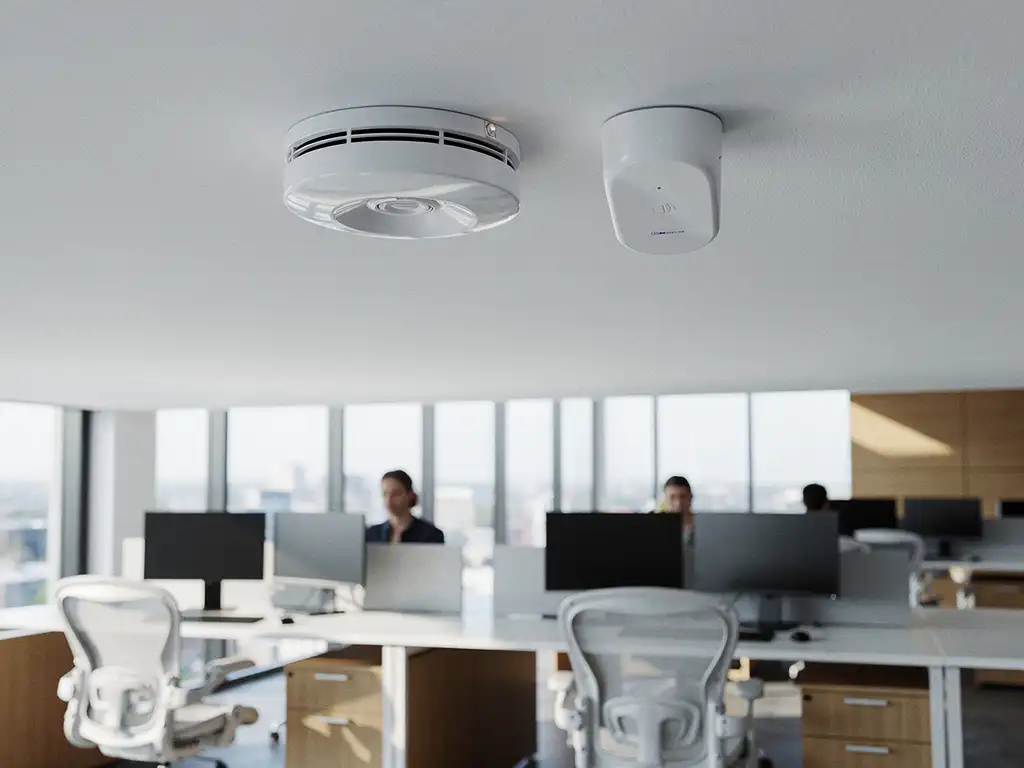
Modern office environments are becoming smarter and safer thanks to the integration of advanced sensor technology. Smart sensors in the office environment play a crucial role in protecting workspaces from fire and water hazards, while also contributing to an efficient and comfortable work environment.
These intelligent detection systems form the backbone of safe office environments and help companies proactively manage risks. From smoke detectors to water detection sensors, the right combination of sensors can prevent significant damage and provide peace of mind for employees and owners.
What are the most important sensors for water and fire detection?
The most important sensors for water and fire detection in office environments are smoke detectors, heat detectors, gas detectors, water leak sensors, and humidity monitors. These sensors work together to create a comprehensive safety system that detects both immediate hazards and potential risks.
Smoke detectors are the first line of defense against fire and are required in all office buildings. They detect smoke particles in the air before flames can spread. Heat detectors complement smoke detectors by detecting rises in temperature, which is particularly useful in areas where smoke detectors might trigger false alarms, such as kitchens or server rooms.
Gas detectors are essential in offices with gas systems or where hazardous vapors may be released. They warn of potentially explosive concentrations before they pose a threat. For water detection, leak sensors are indispensable, especially in utility rooms, near pipes, and under water tanks. Moisture monitoring helps detect leaks early and prevents mold growth.
How do smoke detectors work, and what types are available?
Smoke detectors work by detecting smoke particles in the air using ionization or photoelectric technology. Ionization detectors use a small amount of radioactive material to ionize air molecules, while photoelectric detectors use a beam of light that is interrupted by smoke particles.
There are three main types of smoke detectors for office environments. Ionization detectors respond quickly to rapidly developing fires that produce small smoke particles, such as paper and textile fires. Photoelectric detectors are more effective for smoldering fires that produce large smoke particles. Combination detectors incorporate both technologies and offer the broadest protection.
Modern smart smoke detectors can communicate wirelessly with central systems and offer advanced features such as self-diagnosis, battery status reporting, and integration with other security systems. They can distinguish between different types of smoke and reduce false alarms by using intelligent algorithms.
Which water detection sensors protect against leaks?
Water detection sensors that protect against leaks include point detectors, cable detectors, humidity monitors, and flow meters. These sensors detect water in various ways and can be configured for specific applications and sensitivity levels.
Point detectors are the most common type of sensor and detect water at a specific location. They are installed at floor level near potential leak sources such as pipe joints, water heaters, and air conditioners. Cable detectors consist of a sensitive cable that can be laid over a larger area and detects water along its entire length.
Humidity monitors measure relative humidity and can detect elevated moisture levels that indicate hidden leaks. Flow meters monitor water usage and can detect unusual flow rates that indicate leaks in the system. Smart water detectors can send real-time alerts to smartphones and integrate with building management systems for automated responses.
Where should you place sensors for maximum security?
For maximum safety, sensors should be strategically placed based on a risk analysis, airflow patterns, building layout, and local regulations. Smoke detectors should be installed in every room, in hallways, and near potential fire sources, while water detectors should be placed near pipes, under equipment, and in utility rooms.
Smoke detectors should be installed on the ceiling or high on the wall, since smoke rises. Avoid placing them near ventilation grilles, windows, or doors where air currents could interfere with their operation. In large open-plan office spaces, multiple detectors are needed to ensure full coverage, typically one per 60 square meters.
Water detection sensors must be installed at floor level where water is likely to accumulate. Critical locations include areas near water heaters, pipe connections, washing machines, server cabinets, and under sinks. In utility rooms, sensors should be installed around all water-carrying equipment and pipes.
Heat detectors are ideal for areas where smoke detectors are impractical, such as kitchens, garages, and dusty environments. Gas detectors should be installed based on the type of gas: lighter gases require installation near the ceiling, while heavier gases require detection at floor level.
How Wout Monseurs is helping with smart sensor technology
We integrate advanced sensor technology into our Smart Office solutions, transforming modern offices into intelligent, secure work environments. Our expertise in Smart Office technology enables us to seamlessly integrate sensor systems with other office automation systems.
Our approach to smart sensor technology includes:
- Comprehensive risk analysis and sensor placement tailored to your specific office environment
- Integration of fire and water detection systems with building management systems
- Real-time monitoring and alert systems via smartphone apps
- Preventive maintenance and calibration of all sensor systems
- Training staff in the use of smart security systems
As a full-service project design firm, we ensure that safety sensors are incorporated into your office design from the very beginning. Would you like to learn more about how smart sensors can make your office safer? Contact us for a no-obligation consultation and discover the possibilities for your organization.
Frequently asked questions
How often should sensors be maintained and calibrated?
Smoke detectors must be tested monthly and professionally serviced annually. Water detection sensors require quarterly inspections and annual calibration. Gas detectors have the most intensive maintenance schedule, requiring monthly calibration and semi-annual professional servicing to ensure reliable operation.
Can smart sensors trigger false alarms, and how can you prevent this?
Yes, false alarms can be triggered by dust, cooking fumes, high humidity, or faulty sensors. Prevent this by cleaning regularly, placing the device properly away from ventilation vents and kitchen appliances, and using smart sensors with advanced algorithms that distinguish between real hazards and environmental factors.
What is the cost of installing a complete sensor system?
Prices range from €50 to €150 per smoke detector, €100 to €300 per water detector, and €200 to €500 per gas detector, depending on the model and smart features. For an average office of 200 square meters, the total investment ranges from €2,000 to €5,000, including installation and configuration of the central monitoring system.
How do sensors integrate with existing security and building management systems?
Modern sensors communicate with central systems via wireless protocols such as Wi-Fi, Zigbee, or LoRaWAN. They can be integrated with existing fire alarm systems, access control systems, and HVAC systems to trigger automated responses, such as shutting down ventilation systems in the event of a fire or cutting off the water supply in the event of a leak.
What legal requirements apply to sensors in Dutch offices?
The Building Code requires smoke detectors in all office spaces, hallways, and stairwells. Gas detection is mandatory for gas systems and in areas with an increased risk of explosion. Water detection is not required by law but is strongly recommended for insurance coverage. Professional installation and annual inspections by certified companies are required.
What should you do if a sensor goes off?
In case of a fire alarm: evacuate immediately and call 911. In case of a water leak alarm: locate the source, shut off the main valve if possible, and move valuable items to safety. In case of a gas leak alarm: ventilate the area, do not use any electrical appliances, and leave the area. All alarms must be logged, and the cause must be investigated to prevent recurrence.
Can sensors also help save energy in offices?
Yes, smart sensors help save energy by using occupancy detection for automatic lighting and climate control, optimizing HVAC systems based on air quality measurements, and detecting inefficiencies such as leaks that cause energy waste. This can result in energy savings of 15–30% in modern office environments.