

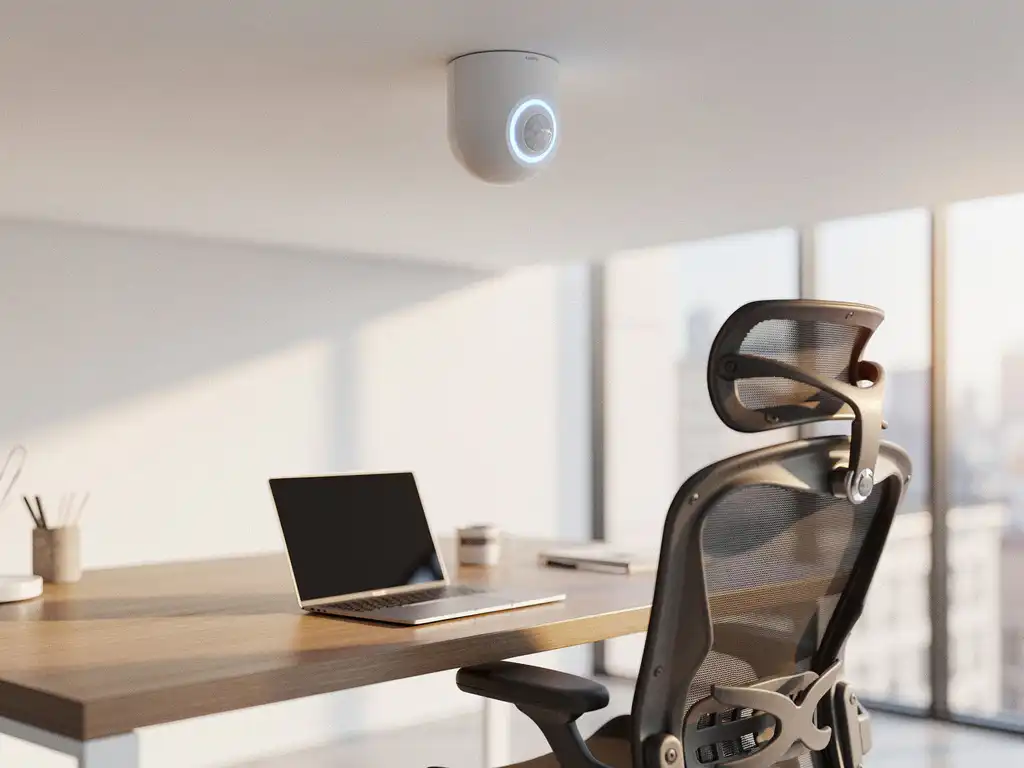
The shift to hybrid work models has fundamentally changed the way we use office spaces. As employees alternate between working from home and working in the office, there is a growing need for intelligent systems that provide real-time insights into space utilization, air quality, and workplace conditions. Smart sensors in the office environment play a crucial role in this.
These advanced technologies make it possible to optimize office spaces for flexible use, reduce energy costs, and ensure a healthy work environment. From occupancy sensors that monitor the availability of workstations to air quality sensors that maintain an optimal indoor climate, the right sensor solutions transform traditional offices into intelligent, adaptive workspaces.
What are sensors for hybrid work models?
Sensors for hybrid work models are smart monitoring devices that collect real-time data on space utilization, environmental conditions, and workplace occupancy in offices where employees work flexibly. These IoT devices monitor parameters such as presence, air quality, temperature, noise levels, and light intensity to optimize office spaces for varying usage patterns.
The sensors help facility managers make data-driven decisions regarding space management and energy consumption. Through continuous monitoring, organizations can use their office space more efficiently, reduce maintenance costs, and create a healthier work environment. In hybrid work models, where occupancy rates vary daily, these sensors provide essential insights for optimizing cleaning schedules, climate control, and space allocation.
Modern sensor systems integrate seamlessly with existing building management systems and can be monitored via dashboards and mobile apps. They enable automatic adjustments to lighting, ventilation, and heating based on actual occupancy, resulting in significant energy savings and greater employee comfort.
What types of sensors are available for offices?
Offices can be equipped with various types of sensors, each with specific functions: occupancy sensors for space utilization, air quality sensors for CO2 and particulate matter, temperature and humidity sensors for climate control, noise sensors for acoustic monitoring, light sensors for automatic lighting, and motion sensors for energy savings.
Occupancy and motion sensors
Occupancy sensors detect the presence of people in workspaces using infrared technology, microwaves, or privacy-protected cameras. These sensors distinguish between occupied and unoccupied spaces and can even count the number of people present. Motion sensors detect activity and are often integrated with lighting systems to automatically turn lights on and off.
Environmental sensors
Air quality sensors measure CO2 concentrations, volatile organic compounds (VOCs), and particulate matter to monitor air quality. Temperature and humidity sensors ensure optimal indoor climate conditions, while noise sensors monitor acoustic comfort. Light sensors measure natural light levels and adjust artificial lighting to ensure optimal working conditions.
Integrated sensor systems
Modern offices often use multifunctional sensors that measure multiple parameters simultaneously. These all-in-one solutions combine occupancy, air quality, temperature, and noise monitoring into a single compact device, simplifying installation and reducing costs.
How do occupancy sensors work in hybrid offices?
Occupancy sensors in hybrid offices work by continuously monitoring room occupancy using infrared detection, microwave technology, or computer vision. They detect when workstations are occupied or vacated, collect data on usage patterns, and transmit this information to central management systems that automatically adjust lighting, climate control, and other facilities.
These sensors are integrated with desk booking systems and provide real-time feedback on available workstations. When an employee enters the office, digital displays or mobile apps show which spaces are available. The sensors also detect when reserved workstations are actually in use, allowing no-show reservations to be automatically released.
In meeting rooms, occupancy sensors monitor whether booked spaces are actually being used and can automatically cancel unused reservations. This maximizes the efficiency of space utilization in hybrid environments where occupancy rates are unpredictable. The collected data helps facility managers optimize cleaning routes, schedule maintenance, and align energy consumption with actual usage patterns.
Advanced occupancy sensors can distinguish between different types of activities and even measure the duration of occupancy. This information is valuable for analyzing workplace productivity and identifying underutilized spaces that could potentially be repurposed.
Why are air quality sensors important for hybrid workplaces?
Air quality sensors are essential for hybrid workplaces because they ensure a healthy work environment by monitoring CO2 levels, volatile organic compounds, and particulate matter. In spaces with variable occupancy, these sensors enable automatic ventilation adjustments, help prevent sick building syndrome, and optimize the indoor climate for fluctuating occupancy levels.
In hybrid offices, occupancy rates vary from day to day, which has a direct impact on air quality. When many employees are present, CO2 levels rise rapidly, which can lead to fatigue, headaches, and reduced concentration. Air quality sensors detect these changes in real time and automatically activate ventilation systems to bring in fresh air.
These sensors are particularly valuable for monitoring volatile organic compounds (VOCs) released from furniture, cleaning products, and office supplies. High VOC concentrations can cause health problems and negatively impact productivity. Through continuous monitoring, facility managers can take proactive measures to improve air quality.
In post-pandemic offices, air quality sensors also play a role in monitoring aerosols and optimizing airflow to minimize the spread of germs. Data from these sensors can be integrated with HVAC systems to automatically adjust ventilation, temperature, and humidity.
How do you choose the right sensors for your office?
Choosing the right sensors requires an analysis of your specific office environment, your employees’ needs, and your budget. Start by identifying your primary objectives: do you want to reduce energy costs, optimize space utilization, or improve air quality? Next, determine which areas require monitoring and which parameters are most critical for your organization.
Needs Analysis and Objectives
Start by identifying your current challenges. Are you experiencing energy waste due to unoccupied, lit spaces? Do employees complain about poor air quality? Are meeting rooms often double-booked? These questions will help you prioritize sensor types. For energy savings, occupancy and light sensors are a priority; for employee comfort, air quality and temperature sensors are essential.
Technical considerations
Consider compatibility with existing systems such as building management systems, desk booking software, and HVAC systems. Choose sensors that communicate wirelessly via Wi-Fi, LoRaWAN, or Zigbee to minimize installation costs. Pay attention to battery life, maintenance requirements, and the ability to perform remote updates and calibration.
Implementation Strategy
Start with a pilot program in a limited number of areas to gain experience before rolling it out to the entire office. Choose a vendor that offers training and support in interpreting sensor data. Establish clear privacy guidelines, especially when using camera-based sensors, and communicate transparently with employees about the purpose of the monitoring.
How Wout Monseurs is helping with smart sensors for hybrid offices
At Wout Monseurs, we seamlessly integrate smart sensors into our Smart Office solutions to optimize hybrid workspaces. With over 60 years of experience in office design, we combine traditional expertise with advanced sensor technology to create intelligent, future-oriented work environments.
Our Smart Office services include:
- Implementation of IoT sensors for occupancy, air quality, and climate control
- Integration with existing building management systems and desk booking tools
- Real-time monitoring dashboards for facility management
- Automatic adjustments to lighting, ventilation, and temperature
- Energy-saving systems that can reduce costs by up to 90%
As a full-service project designer, we offer a comprehensive package that combines sensor technology with ergonomic furniture, acoustic solutions, and sustainable office furnishings. From design to completion, we create an intelligent work environment that perfectly aligns with your hybrid work model.
Discover how smart sensors can transform your office. Contact us for a no-obligation consultation and experience our solutions at our Experience Center in Breda.
Frequently asked questions
How many sensors do I need for my office?
The number of sensors depends on the size of your office and your specific goals. As a general rule of thumb: one occupancy sensor for every 20–30 workstations, one air quality sensor for every 50–100 m², and motion sensors at every entrance and exit. Start with a pilot in a few rooms to better assess your needs before expanding.
What is the cost of installing sensors in a hybrid office?
The investment costs range from €50 to €200 per sensor, depending on the type and functionality. Multifunctional sensors are more expensive but more cost-effective per measured parameter. Expect a payback period of 1 to 3 years due to energy savings and increased space efficiency. Wireless sensors significantly reduce installation costs.
How do sensors handle employee privacy?
Modern sensors are designed with privacy-by-design principles in mind. Occupancy sensors detect presence without identifying individuals. Camera-based sensors use edge computing to process data locally without storing images. Be transparent about the purpose of monitoring and establish clear privacy guidelines to maintain trust.
Can sensors be integrated with our existing office equipment?
Ja, de meeste moderne sensoren ondersteunen standaard protocollen zoals wifi, LoRaWAN, en Zigbee voor eenvoudige integratie. Ze kunnen worden gekoppeld aan bestaande HVAC-systemen, verlichtingsinstallaties, deskbookingsoftware en gebouwbeheersystemen. Een goede leverancier biedt API’s en ondersteuning bij de integratie.
What happens if sensors malfunction or give incorrect readings?
High-quality sensors have a service life of 5–10 years and are equipped with self-diagnostic functions that detect malfunctions. Implement redundancy in critical areas and choose suppliers that support remote monitoring and automatic calibration. Establish maintenance contracts for regular inspections and battery replacement.
How soon will I see results after installing the sensors?
Directe voordelen zoals automatische verlichting en klimaatbeheersing zijn onmiddellijk zichtbaar. Energiebesparingen worden binnen de eerste maand meetbaar, terwijl optimalisatie van ruimtegebruik en schoonmaakschema’s na 2-3 maanden duidelijk wordt. Voor volledige ROI-realisatie en gedragsverandering van werknemers reken je op 6-12 maanden.
What data do I receive from the sensors, and how do I interpret it?
Sensoren leveren realtime data over bezettingsgraden, luchtkwaliteit (CO2, VOC’s), temperatuur, vochtigheid en geluidsniveaus. Deze data wordt gepresenteerd in gebruiksvriendelijke dashboards met trends, alerts en aanbevelingen. Veel leveranciers bieden training en analysediensten om je team te helpen bij het interpreteren van data en het nemen van datagedreven beslissingen.