

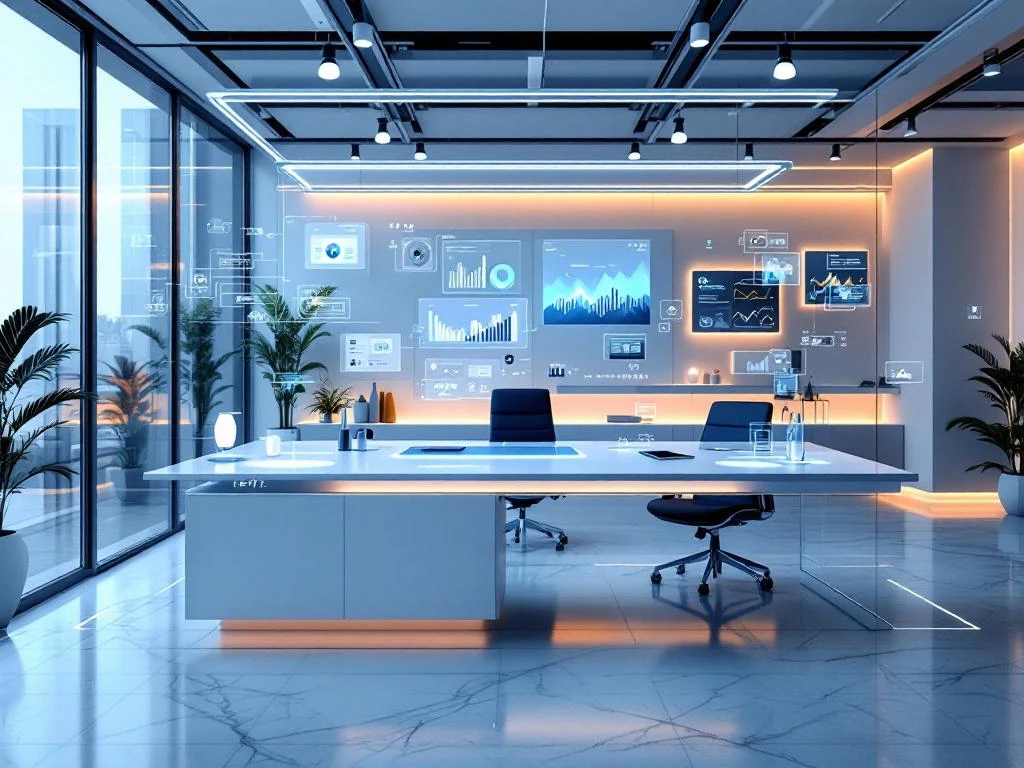
Smart workplaces utilize four core technologies: IoT sensors for space monitoring, artificial intelligence for automation, cloud computing for data integration, and wireless connectivity for flexible access. These technologies work together to create an intelligent office environment that adapts to your needs, saves energy, and increases productivity.
What are the most important technologies in smart workplaces?
The four key technologies that enable smart workplaces are IoT sensors, artificial intelligence, cloud computing, and wireless connectivity. These systems collect data, analyze patterns, and automate processes to make your workplace smarter.
IoT sensors form the basis of every smart office system. They measure movement, temperature, air quality, and noise levels in real time. This information is forwarded to AI systems that recognize patterns and automatically make adjustments to lighting, climate, and room layout.
Cloud computing ensures that all data is stored centrally and accessible from any location. This enables remote working and ensures synchronization between different office locations. Wireless connectivity, such as WiFi 6 and 5G, guarantees that all devices can communicate quickly and reliably.
The magic happens when these technologies work together. Sensors detect when you enter, the AI automatically adjusts the lighting and temperature to your preferences, and your settings are saved in the cloud for next time.
How do IoT sensors work in modern office environments?
IoT sensors in offices function as digital senses that continuously monitor the environment. Motion sensors detect presence, light sensors measure natural light, temperature sensors control the climate, and air quality sensors monitorCO2 levels and humidity.
Motion sensors are most visible in smart offices. They automatically turn on the lights when you enter a room and dim them when there is sufficient daylight. This saves up to 30% on energy costs without you having to do anything.
Air quality sensors are particularly useful for your health and concentration. WhenCO2 levels become too high, they automatically send a signal to the ventilation system. ExcessiveCO2 levels can cause headaches and concentration problems.
Temperature and humidity sensors work together with the climate control system to create optimal working conditions. They learn from your behavior and adjust the temperature before you even notice. They also detect empty rooms and automatically reduce the heating or air conditioning.
Modern sensors are wireless, have a battery life of several years, and are so small that they are barely noticeable. They communicate with the central system via protocols such as Zigbee or LoRaWAN.
What role does artificial intelligence play in smart workplaces?
Artificial intelligence in smart workplaces analyzes patterns from sensor data and predicts your needs. Machine learning algorithms learn from your behavior and automatically adjust lighting, temperature, and room layout without you having to consciously think about it.
Predictive analytics is an important AI application in offices. The system learns when different rooms are used and adjusts the climate control accordingly. If you use the meeting room every Tuesday at 9:00 a.m., the AI ensures that it is at the right temperature before you arrive.
Personal preferences are saved and automatically applied. The AI remembers that you like bright light during presentations, but prefer softer lighting for administrative work. The system recognizes you via facial recognition or your badge and adjusts the environment accordingly.
Space optimization is another strength of AI in offices. The system analyzes which workspaces are used most and can make suggestions for a better layout. It also predicts when meeting rooms will be available and suggests alternative locations in case of overbooking.
Voice assistants and chatbots help with everyday tasks, such as reserving rooms, adjusting the temperature, or finding colleagues. They are becoming increasingly adept at understanding natural language and can perform more complex tasks.
Why is cloud computing important for smart office solutions?
Cloud computing forms the backbone of smart office systems, because it stores data from all sensors and devices centrally and makes it accessible from any location. Without cloud technology, smart offices would only be able to operate locally and remote access would be impossible.
Data integration is the greatest strength of cloud computing in offices. Information from motion sensors, climate control systems, security cameras, and access control is combined into a single platform. This gives you a complete overview of your office and enables advanced analysis.
Remote access means you can manage your office from any location. Using an app on your phone, you can adjust the heating before you go to the office, check which rooms are occupied, or activate security. This is especially useful when working in a hybrid environment.
Scalability is a major advantage of cloud solutions. As your business grows and you add more sensors or users, the system automatically scales with you. You don't need to buy new servers or install software on every computer.
Real-time synchronization ensures that changes are immediately visible on all devices. If you reserve a meeting room on your laptop, your colleague will see this immediately on their phone. Software updates are also automatically rolled out to all connected devices.
Cost efficiency is a practical advantage, because you only pay for what you use. Instead of having expensive servers and IT management in-house, you pay a monthly fee to the cloud provider, who takes care of everything for you.
How Wout Monseurs assists with smart office technology
We seamlessly integrate smart technologies into your entire office design. From the initial design to the final implementation, we ensure that sensors, AI systems, and cloud solutions work perfectly with your workplaces and office furniture.
Our approach begins with understanding your work processes and requirements. We not only design attractive workspaces, but also consider how technology can improve your daily tasks. Examples include automatic height adjustment of desks, smart lighting that adjusts to daylight, and climate control that adapts to the number of people present.
Technology integration takes place during the design phase, so that all cabling and sensors are concealed from view. We work with specialist technology partners to ensure that your smart office system is reliable and easy to operate.
Would you like to know how smart technology can improve your office? Contact us for a no-obligation consultation. On our smart office page, you will find more information about our intelligent office solutions and concrete examples of what is possible.
Frequently asked questions
What are the costs of implementing smart office technology?
The costs vary greatly depending on the size of your office and the desired functionalities. A basic system with motion sensors and smart lighting costs around €50-100 per workstation, while comprehensive systems with AI and full climate control can cost up to €200-400 per workstation. We recommend starting with a pilot in one room to experience the benefits before upgrading the entire office.
How long does it take to install a smart office system?
Installation of a basic system usually takes 2-5 business days, depending on the size of your office. More complex systems with extensive AI integration and customized climate control can take 1-2 weeks. We schedule installation to minimize disruption to your daily operations, often during weekends or after business hours.
Is my data secure in a smart office system?
Yes, modern smart office systems use enterprise-grade security with end-to-end encryption and comply with GDPR legislation. Sensor data is stored anonymously and personal preferences are only accessible to the user themselves. We only work with certified cloud providers that meet the highest security standards and have servers within Europe.
Can I manage the smart office system myself, or do I need technical support?
Most systems are designed for easy use via intuitive apps and dashboards. Daily management tasks such as adjusting preferences or reserving rooms can be done by anyone. We offer maintenance contracts for technical updates and troubleshooting, but many systems operate largely autonomously after the initial installation.
What common mistakes should I avoid when implementing smart office technology?
The biggest mistake is choosing too many features at once without preparing your employees. Start small with basic features such as smart lighting and climate control. Also, ensure good WiFi coverage before installing sensors, and train your team in the use of the new systems. Avoid cheap solutions that cannot grow with your business.
How do I measure the return on my smart office investment?
Measure concrete results such as energy savings (often a 20-30% reduction), increased space efficiency, and reduced facility costs. Also ask employees for feedback on comfort and productivity via surveys. Most systems offer dashboards with real-time data on energy consumption, space usage, and system performance, allowing you to quantify the benefits and report them to management.